

Guides
How to Choose a Commercial Turnstile Manufacturer (2026 Buyer's Checklist)
A vendor-neutral checklist for evaluating commercial turnstile manufacturers in 2026: lead times, warranty, certifications, US vs imported, and integration support.

Gatestile Engineering Team
Engineering & Specifications, Gatestile
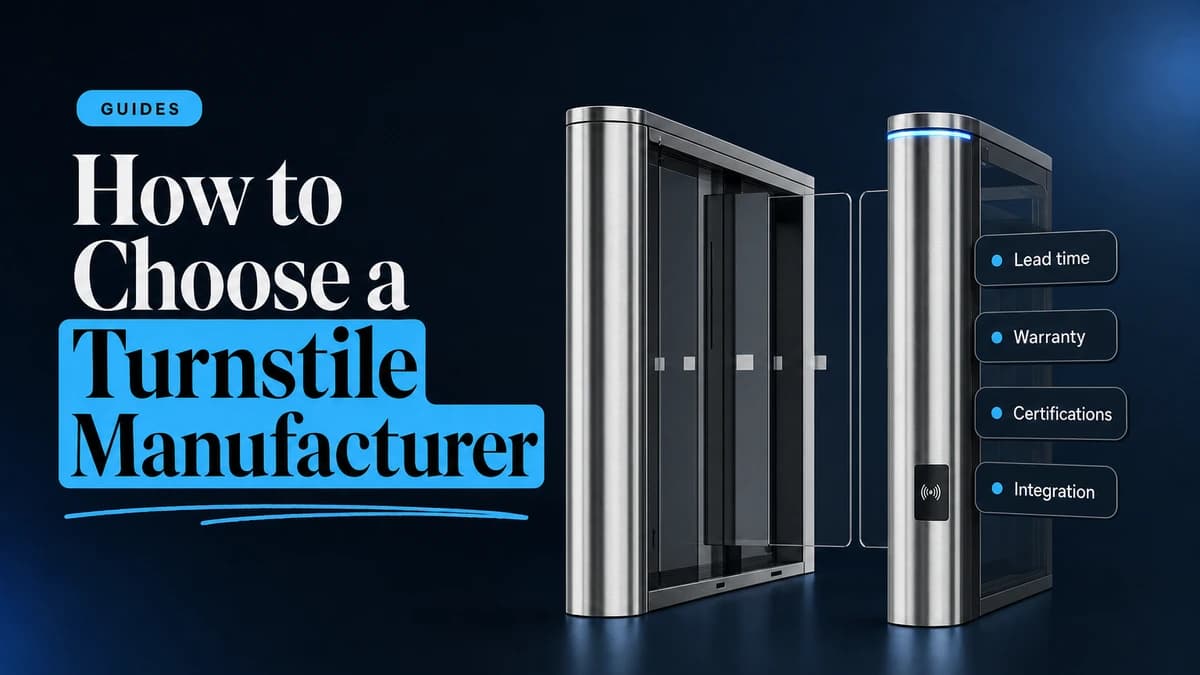
Search "turnstile manufacturers" and you get two kinds of results: manufacturer product pages selling you their own line, and listicles ranking ten vendors by no stated method. Neither tells you how to actually evaluate one. This guide does. Every figure below is either a Gatestile specification or a cited public standard, current as of July 2026, and where a number is our own positioning rather than a datasheet value, we say so.
This checklist assumes you have already worked out that your gap is the physical entrance hardware, not the electronic access-control system itself. If you are not sure which side of that split your project needs, our access control manufacturer disambiguation guide walks through the difference before you shortlist anyone.
Vendor choice and budget are two sides of one decision. See the 2026 commercial turnstile cost guide for the price bands these factors move, and the access control integration guide for the head-end support to demand in writing.
The seven factors that decide the vendor, before price
Price is easy to compare and the worst place to start, because it hides the variables that actually determine total project cost. Score every manufacturer you are considering on these seven factors first, get each answer in writing, and only then line up the quotes. A structured scorecard also gives you a defensible paper trail if the purchase goes through procurement or a bid.
| Dimension | What strong looks like | What weak looks like |
|---|---|---|
| Lead timeStrong: 3 to 8 weeks, published, domestic. Weak: vague, or 10 to 16 week import with no schedule guarantee. | Best | Weak |
| WarrantyStrong: 5-year hardware, clearly scoped. Weak: 1 year, or coverage that is undefined until something breaks. | Best | Weak |
| CertificationsStrong: ISO 9001, UL-listed components, ADA configs, documented. Weak: claimed but not evidenced on request. | Best | Adequate |
| Domestic vs importedStrong: US assembly plus US spares stock. Weak: fully imported with overseas-only parts. | Good | Adequate |
| Integration supportStrong: native OSDP and Wiegand, tested head-end compatibility. Weak: proprietary or undocumented. | Best | Weak |
| Spares and service reachStrong: stocked parts, defined service path. Weak: parts on order from overseas, no service story. | Good | Weak |
| Published specs and drawingsStrong: datasheets and drawings ready for submittals. Weak: marketing copy only, nothing an architect can spec from. | Best | Adequate |
The sections below unpack the four factors buyers get wrong most often. The other three (spares, published specs, and a plainly scoped warranty) follow the same rule: ask for it in writing, and treat a vague answer as the answer.
Lead time: the number that quietly sets your real cost
A turnstile is built hardware, not shelf stock, so lead time is a real design input, not a footnote. The split that matters is domestic versus imported. US-assembled units commonly ship in 3 to 8 weeks depending on the product line, while fully imported equivalents commonly quote 10 to 16 weeks, and custom finishes add roughly 2 to 3 weeks either way.
That gap is where import savings quietly disappear. If a lobby opening is tied to a certificate of occupancy and the fully-imported turnstiles are eight weeks late, the cost of the delay (idle space, rescheduled trades, a temporary staffed entrance) routinely exceeds the hardware price difference. Ask every manufacturer for a written standard-configuration lead time and a written custom-finish adder, and ask where the unit is assembled. If they cannot give you a firm date, that is a schedule risk you are absorbing.
Warranty: read what it covers, not just how long
Warranty length is a proxy for how much a manufacturer trusts its own build. Five years on hardware is a strong benchmark for commercial turnstiles, but the length matters less than the scope. A five-year warranty that quietly excludes the motor is weaker than a well-scoped shorter one.
Read the coverage line by line. A solid commercial warranty covers the motors, electronics, sensors, and metalwork, the parts that actually fail in service. Glass is commonly covered for manufacturing defects only, not impact or field damage, which is normal but worth confirming. Gatestile warrants hardware for five years on those terms. Whatever the vendor, get the covered-components list in writing before you sign, because "five-year warranty" and "five-year warranty on the frame only" are very different promises.
Certifications: certified versus supports, and why the difference matters
Certifications are where careful buyers separate real manufacturers from resellers, and where imprecise language causes the most confusion. For US commercial work, the baseline set is an ISO 9001 quality system, UL-listed electrical components, FCC-compliant control electronics, and ADA-compliant lane configurations wherever an accessible route is required (the 2010 ADA Standards require a 32 inch, 815 mm, minimum clear width per section 404.2.3).
Ask for documentation and country-of-origin information in writing. A real manufacturer provides it; a reseller often cannot. If your project is federal or government-funded, ask specifically about Buy American documentation rather than accepting a blanket compliance claim, and confirm the contracting path.
Integration support: the factor integrators weigh first
If a security integrator is specifying the project, integration support outranks almost everything else, because a turnstile is an actuator that obeys your access-control system, not a competing system. The questions that matter are concrete: does the lane natively support OSDP (the modern, encrypted, SIA-recommended reader protocol) and Wiegand for legacy panels? Is it tested against your head-end (Lenel, Genetec, Honeywell, S2)? Does it provide the fire-alarm release and request-to-exit interfaces your egress plan needs?
A manufacturer that publishes a compatibility matrix and speaks fluently about OSDP versus Wiegand is one an integrator can work with. One that answers integration questions with "it works with everything" has not thought about your panel. Our turnstile integration guide covers the protocol and interlock details worth confirming with any manufacturer before you specify.
How to size us up, on the same checklist
It would be dishonest to publish an evaluation checklist and exempt ourselves from it, so here is Gatestile scored on the same seven factors, with sources you can check. We make turnstiles; this is our own scorecard, and you should verify every line the same way you would verify a competitor's.
That last column is the point of an honest checklist: no manufacturer wins every row, so decide which rows matter most for your project and weight accordingly. A time-critical Class A lobby weights lead time and integration; a remote back-of-house gate might weight price.
The 60-second manufacturer screen
Before you shortlist any turnstile manufacturer, get these seven answers in writing:
- What is your standard-configuration lead time, and where is the unit assembled?
- How long is the hardware warranty, and exactly which components does it cover?
- Can you provide ISO 9001, UL, and ADA documentation on request?
- Do you stock spare parts domestically, and what is the service path if a unit fails?
- Does the lane natively support OSDP and Wiegand, and is it tested against my access-control head-end?
- Are published datasheets and drawings available for the model you are proposing?
- Do you sell direct, through integrators, or both?
A manufacturer that answers all seven crisply is one you can build a submittal around. One that dodges even two of them has told you something. When you are ready to score us against that list with real numbers for your project, send us the entrance layout and lane count.
Frequently asked questions
- Score every vendor on the same seven factors: published lead time, warranty length and what it covers, certifications and listings (ISO 9001, UL-listed components, ADA-compliant configurations), domestic vs imported assembly, integration support for your access control head-end, spare-parts and service reach, and whether specs and drawings are published for submittals. Get all seven in writing before you compare price, because a lower sticker with a 14-week import lead time and no US spares is rarely the cheaper project.
Keep reading
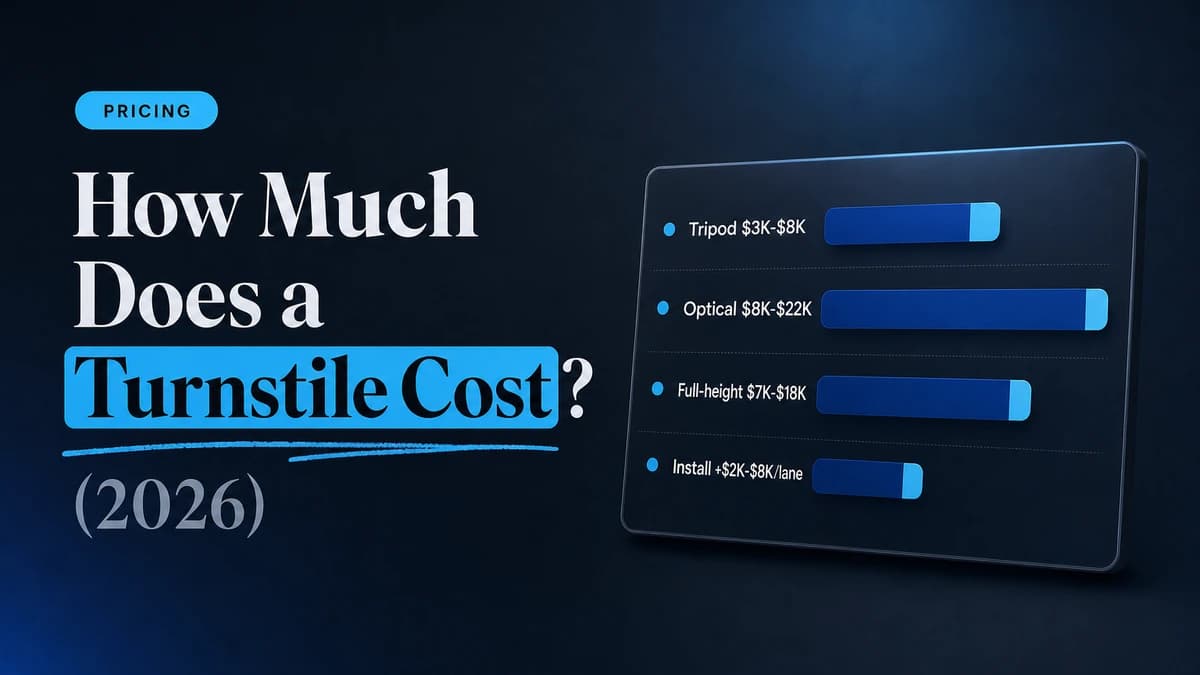
How Much Does a Commercial Turnstile Cost in the US? (2026 Real Price Bands + Installed-Cost Breakdown)
A 2026 cost guide for commercial turnstiles in the US. Real hardware bands, transparent installed-cost line items, lead times, and 5-year TCO. No fluff.
Gatestile Engineering Team
May 6, 2026
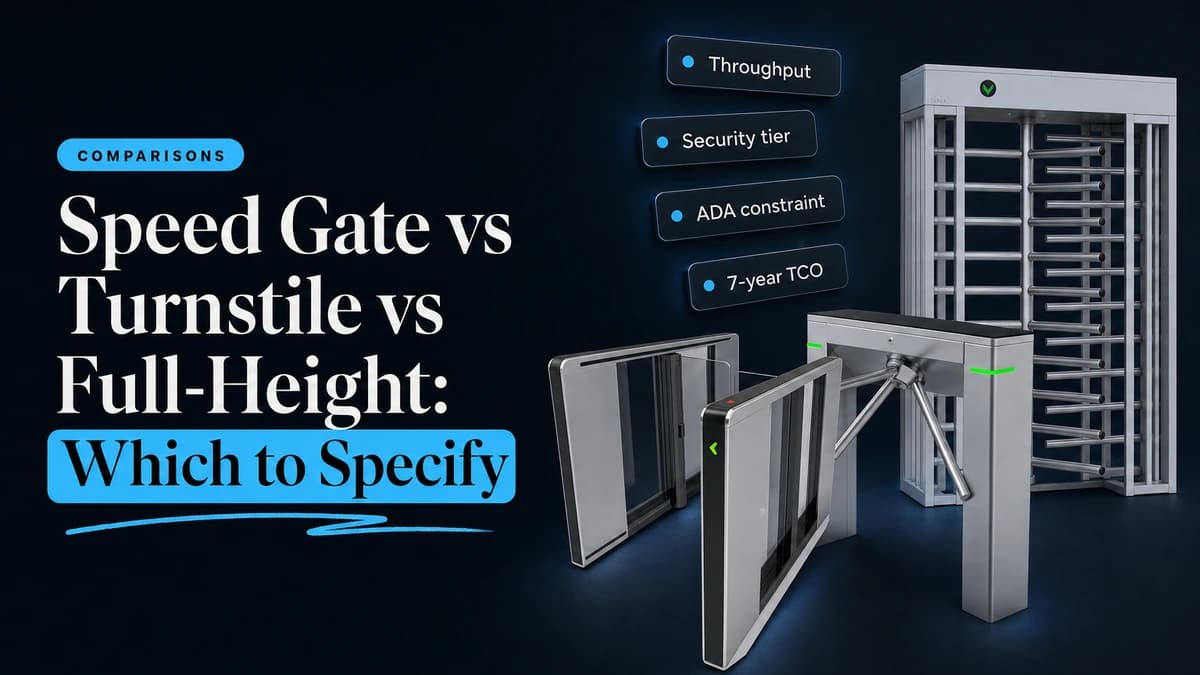
Speed Gate vs Turnstile vs Full-Height: A US Specifier's Guide (2026)
The 2026 specifier's guide to speed gates vs tripod vs full-height turnstiles. Throughput, security tier, ADA and NFPA, vertical fit, and 7-year TCO.
Gatestile Engineering Team
Apr 29, 2026
 New
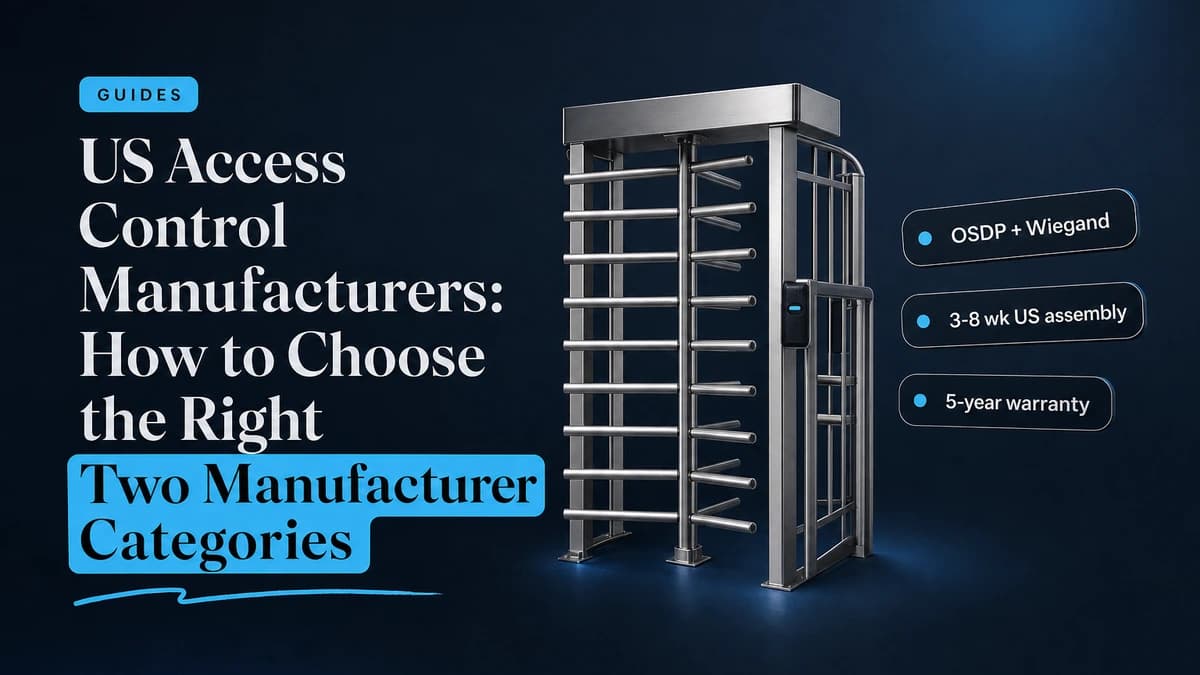
NewUS Access Control Manufacturers: How to Choose the Right Category
Access control manufacturer searches cover two different vendor types. Learn the split, how they integrate, and which one your project actually needs.
Gatestile Engineering Team
Jul 28, 2026