

Pricing
How Much Does a Commercial Turnstile Cost in the US? (2026 Real Price Bands + Installed-Cost Breakdown)
A 2026 cost guide for commercial turnstiles in the US. Real hardware bands, transparent installed-cost line items, lead times, and 5-year TCO. No fluff.

Gatestile Engineering Team
Engineering & Specifications, Gatestile
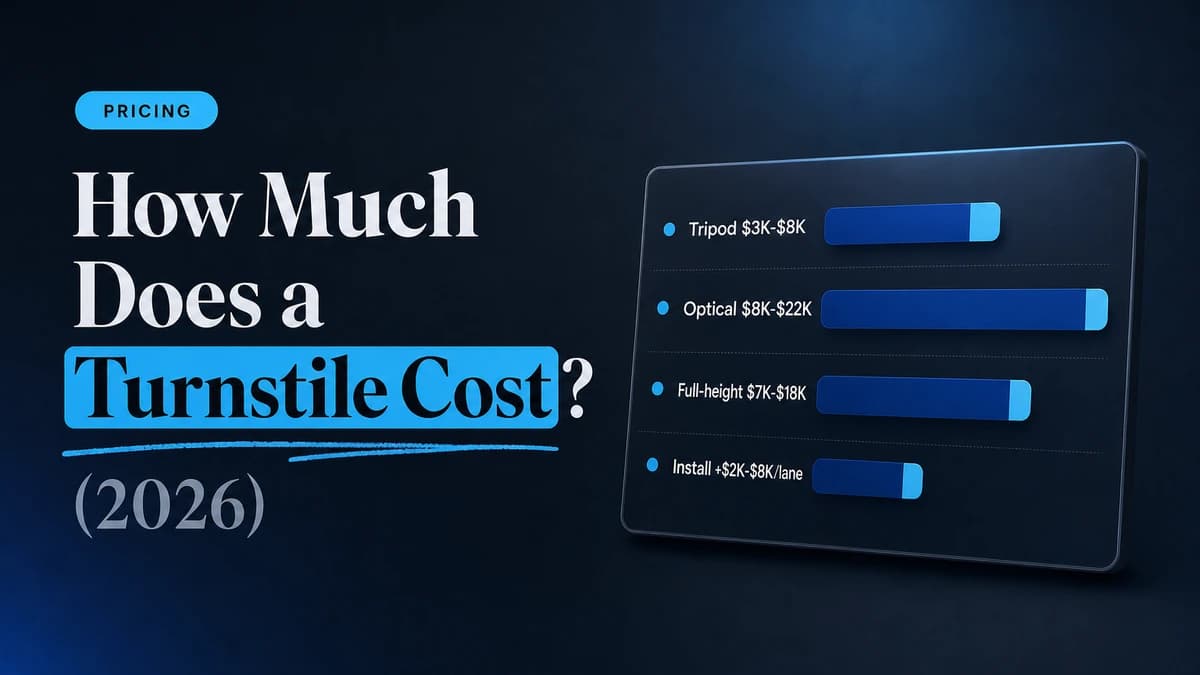
This is what a transparent 2026 quote actually looks like in the US. We pulled the numbers from public manufacturer price guides (Mairs, Hayward, Turniq, FDC, Boon Edam, Alvarado, dormakaba), our own integrator-side estimates for installation labor, and 25 years of factory-floor pricing from our own US assembly operation. Where a number is a published manufacturer figure we cite it. Where it's an integrator-side estimate we say so. Numbers last verified July 2026.
If you want a quote on your specific project, contact us, but read this first so you can sanity-check whatever you get back.
Price is only half the decision. Once you have a number, the turnstile manufacturer selection guide covers who to buy from, and the full-height turnstile buyer's guide covers what you actually get at each price band.
The honest 30-second answer
A US commercial turnstile, before installation, costs somewhere between $3,000 and $45,000 per lane. The 15× spread is real, and it maps cleanly onto what you're buying:
What moves you within each band: stainless grade (304 vs 316), enclosure rating (IP54 indoor vs IP65 outdoor), motor and gearbox quality, glass thickness on speed gates, the access-control reader package you bolt on, and whether you ship from a US factory or an overseas one.
What gets added on top: freight, anchoring, conduit and low-voltage wiring, commissioning. Realistically that's another 25–60% of the hardware price for a typical installation.
What nobody tells you about: AHJ inspections, signage that the code requires, and the cost of cutting and re-finishing the floor where you anchor the unit.
The rest of this guide takes those numbers apart so you can build your own 2026 quote and check whatever sales rep is selling you against reality.
Hardware bands by product class
Hardware-only price per lane, before any install costs. These are 2026 ranges based on public US price guides plus integrator-side data on what's actually quoted on real projects.
| Product class | Entry | Mid-tier | Premium | What you get at premium |
|---|---|---|---|---|
| Tripod turnstile | $3,000 | $5,500 | $8,000 | AISI 316, OSDP, dual reader, motorized drop-arm |
| Three-quarter height | $5,000 | $8,500 | $12,000 | AISI 316, IP54+, biometric-ready, anti-pinch |
| Full-height turnstile | $7,000 | $11,000 | $18,000 | AISI 316, IP65, stadium-spec, dual-direction |
| Optical speed gate (single lane) | $8,000 | $14,000 | $22,000 | 10mm tempered glass, 3D detection, ADA wide-lane |
| Swing gate (ADA, single lane) | $10,000 | $14,000 | $20,000 | AISI 316, 100cm passage, integrated detection |
| Glass rotating (mantrap) | $25,000 | $40,000 | $60,000+ | Custom curved glass, biometric, signature finish |
| Sanitary barrier (washdown) | $8,000 | $12,000 | $18,000 | AISI 316, IP65, FDA-adjacent finishes |
A few things to call out so you don't misread the table:
- "Per lane" matters. A two-lane optical speed gate isn't 2× a single-lane unit. There's only one shared electronics cabinet. Expect roughly 1.7× pricing for the second lane and 2.4–2.6× for three lanes.
- Glass rotating is priced per unit, not per lane. A glass rotating turnstile is a single rotating chamber that throughputs one person at a time. The "premium" $60K+ tier is where you land when you add curved laminated glass, biometric integration, and a custom architectural finish to match the lobby it's designed for.
- Bands assume standard configurations. Add roughly 15–25% if you need custom finishes (PVD-coated stainless, brass, bronze), and 10–20% for biometric reader integration done at the factory.
What drives the price within each band
Two units of the same product class can sit at opposite ends of the band. Here's what's actually moving the number.
Material grade: AISI 304 vs 316 stainless
Most commercial turnstile chassis are AISI 304 stainless. Spec it up to AISI 316 (marine-grade, higher molybdenum content, far better corrosion resistance) and you're paying roughly 12–18% more on the chassis. Worth it for any outdoor install, any coastal site, and any healthcare or food-processing facility that washes the unit down.
Enclosure rating: IP54 vs IP65
IP54 (dust-protected, splash-protected) is fine indoors. IP65 (dust-tight, water-jet-protected) is the spec you need outdoors, on parking-deck installs, on transit platforms, and anywhere you can't trust the weather. The jump from IP54 to IP65 typically adds 8–15% because of the gasketing, cable glands, and weatherproof reader cutouts. (Ingress protection classes are defined in IEC 60529.) Our metro and transit access control guide covers what an IP65-rated fare gate needs to hold up on an exposed station platform.
Reader and credential package
A turnstile with no reader is just a chassis. What you bolt on changes the price meaningfully (and on the wire protocol, specify OSDP over legacy Wiegand on any new build):
| Reader package | Add-on cost | Notes |
|---|---|---|
| Single 125kHz prox (legacy) | $150–$300 | Cheap, low-security, being phased out |
| Single 13.56MHz iCLASS / DESFire | $300–$600 | Modern standard for most US offices |
| Dual reader (in/out, both directions) | $500–$1,100 | Standard on speed gates |
| Mobile credential (BLE/NFC) | $400–$900 | HID Origo, OpenPath, Genea, increasingly common |
| Biometric (face / fingerprint) | $1,200–$3,500 | Suprema, IDEMIA, Hanvon, adds significant lead time |
| QR code (transit / event) | $300–$700 | Matrix scanner, top-down or angled mount |
Glass thickness (speed gates only)
Speed gate barriers ship with 8mm, 10mm, or 12mm tempered or laminated safety glass. 10mm tempered is the Class A office standard. Spec up to 12mm laminated for forced-entry resistance and you're paying roughly 8–12% more on the lane.
Motor and gearbox
Brushless DC motors with planetary gearboxes are the high-end standard: quieter, longer MTBF (typical manufacturer claim: 5–10 million cycles), and lower service cost over the life of the unit. Cheaper units use brushed DC or induction motors with worm gearboxes that sound like a dishwasher under load and need bearing replacements every 2–3 years on a high-traffic site.
Domestic vs imported
A US-manufactured turnstile typically lands 8–18% above an equivalent imported unit on the bare hardware number, but you save 6–10 weeks of lead time and you can drive to the factory if something goes wrong. On a serviceable hardware item with a 10–15 year deployment life, that's not a small consideration.
The installed cost: the line items nobody quotes
Hardware is one number. What you pay your security integrator (or what you pay your low-voltage contractor if you go direct) is another. This is the line-item table you should be asking for, and that nobody sends you unprompted:
| Line item | Per-lane cost | What's in it |
|---|---|---|
| Freight (LTL, lift-gate) | $400–$1,200 | Factory to site, depending on distance and lane count |
| Anchoring + floor prep | $300–$600 | Wedge anchors, leveling, surface prep |
| Conduit + low-voltage wiring | $1,500–$4,000 | Power, network, reader pulls; varies by lobby distance |
| Commissioning + ACS integration | $800–$2,000 | Reader pairing, ACS programming, smoke testing |
| AHJ inspection / permitting | $200–$800 | Often missed, required in most US jurisdictions |
| Floor patch / tile re-cut | $300–$1,500 | If you're cutting an existing finished floor |
| Signage (code-required) | $100–$400 | Egress signage, ADA passage signage |
| Total (typical) | $3,600–$10,500 | Add 15–25% for outdoor / IP65 sites |
Some things to flag:
- The wiring number explodes on retrofits. A new-build site where you can drop conduit through the slab during construction is at the low end. A 30-year-old marble lobby where you have to fish wire through a finished ceiling can hit $6K–$8K per lane on its own.
- Commissioning is where projects go sideways. It's the last 5% of the install but it's where the integrator pairs the reader to the access control head-end (Lenel OnGuard, Genetec Security Center, Honeywell Pro-Watch, S2 NetBox) and runs smoke tests. Skimping here is how you end up with a $30K speed gate that doesn't unlock when you badge.
Lead times: domestic vs imported
This is the variable that breaks projects. The lead time you're quoted at PO is rarely the lead time you actually see, but here's the realistic 2026 baseline:
| Source | Standard config | Custom finish | Custom lane count |
|---|---|---|---|
| US factory (East Coast) | 4–6 weeks | 6–10 weeks | 8–12 weeks |
| US factory (West Coast) | 5–7 weeks | 7–11 weeks | 9–13 weeks |
| European import | 10–14 weeks | 14–18 weeks | 16–22 weeks |
| Asian import | 12–16 weeks | 16–22 weeks | 20–26 weeks |
What extends a lead time beyond the baseline:
- Custom finishes. PVD-coated stainless, bronze, brass, and color-matched powder coats add 2–4 weeks because they're done in a separate finishing line.
- Biometric integration done at the factory. Adds 2–3 weeks because the readers ship from a different supplier and have to be married to the chassis on the line.
- Container delays (imports only). Ocean freight from Asia has been variable since 2020. Add 2–4 weeks of buffer to whatever the manufacturer quotes you for transit.
- US customs. Imports get held at port. CBP inspection adds 5–10 days when it happens.
The single biggest lever you have on lead time is buying domestic. A US factory can ship a standard-spec speed gate in 4 weeks. The same unit sourced from Italy or China will be on a boat for 4 weeks before it ever clears US customs.
The hidden costs nobody quotes
These don't usually show up on the original quote and they catch buyers out. Bake them into your budget.
AHJ inspection and permitting
Most US jurisdictions require an Authority Having Jurisdiction (AHJ) sign-off on egress hardware in commercial buildings, applying NFPA 101 and IBC Chapter 10 egress requirements to the lane hardware. That's the local fire marshal or building department. The permit itself runs $200–$500 in most cities, but the real cost is rework if your install fails. Expect 1–2 trips back to the site to address corrections.
Code-required signage
ADA-passage signage is also typically required at any wide-lane configuration. Budget $100–$400 per project for signage and you'll be fine.
Floor repair and finish work
Anchoring a turnstile means cutting through whatever's on the floor: carpet, tile, marble, polished concrete. Plan for floor patch and re-finish in your budget; it's typically $300–$1,500 per lane and is almost always charged separately by the GC.
Spare parts and the first service visit
Most commercial turnstile manufacturers want you to buy a small spare-parts kit at PO time (drive belts, photocells, a spare control board). It's $400–$900 per lane and saves you a $500 service call the first time something fails. The first service visit after install (usually 6–12 months in for a tune-up) is another $400–$800.
5-year total cost of ownership
The hardware-only price is the headline. Total cost of ownership over a typical 5–10 year deployment is what actually hits your operating budget.
| Category | Year 0 | Years 1–5 |
|---|---|---|
| Hardware (mid-tier optical, AISI 316) | $14,000 | - |
| Installation (freight + anchoring + wiring + commissioning) | $5,500 | - |
| AHJ + signage + floor patch | $1,200 | - |
| Annual service contract | - | $600/yr × 5 = $3,000 |
| Spare parts kit + first service visit | $650 | - |
| Replacement parts (drive belts, sensors, control board) | - | $1,800 cumulative |
| Downtime exposure (lost productivity) | - | $0–$3,000 depending on tenant base |
| 5-year total | $21,350 | $4,800–$7,800 |
| **Total cost of ownership** | **$26,150–$29,150** | - |
The total cost of ownership for a single mid-tier optical speed gate lane runs roughly 2× the hardware-only sticker price over a 5-year window. That ratio gets worse on cheaper hardware (more service visits, shorter MTBF) and better on premium hardware that holds up.
Two ratios worth running on every turnstile quote: hardware-to-installed and year-zero-to-5-year TCO. Both should land near 2×. If hardware-to-installed comes back at 1.2×, the install line is understated. If TCO comes back at 1.3×, the service line is understated. Either way, ask the vendor to show their math.
Direct from manufacturer vs through an integrator
The single most common question we get from facility managers comparing quotes:
| Path | Hardware price | What's included | When it makes sense |
|---|---|---|---|
| Direct from manufacturer | Best price (-25% to -40%) | Hardware, freight, factory commissioning support | You have an in-house facilities team or a separate low-voltage GC |
| Through a security integrator | Marked up 25–40% | Hardware + project management + install labor + access-control programming + warranty single-point | Multi-system jobs (turnstile + ACS + cameras + intercom), single-source accountability |
| Hybrid (direct + LV contractor) | Mid-range | Hardware direct, install via your existing low-voltage subcontractor | Best of both, the most common path for sophisticated buyers |
The hybrid path is what most experienced facility managers run on a 2nd or 3rd turnstile project. They've already paid integrator markup once, learned the install patterns, and now they buy the hardware direct and bring in a known LV contractor for the wiring.
How to get an honest quote
Three things to ask any salesperson sending you a turnstile quote in 2026:
- "Itemize the install." Hardware, freight, anchoring, conduit, commissioning, AHJ. Eight line items, not "Project total: $XX,XXX."
- "What's the realistic lead time including custom finishes and reader integration?" If they quote you the bare-hardware standard-spec lead time without flagging that custom finishes add 2–3 weeks, they're either inexperienced or hoping you don't notice.
- "What's your service contract structure?" A good rep will quote you a 1-year warranty plus an annual service contract option. A bad rep won't bring it up because they're optimizing for the close, not the relationship.
If you're shopping Gatestile specifically, we publish our partner-tier pricing (no opaque markup), we're a 25-year US factory, and our standard-config lead time is 3–8 weeks domestic depending on the product line. Get in touch when you're ready for real numbers.
Frequently asked questions
- Commercial turnstiles range from about $3,000 per lane for entry-level tripod turnstiles to $45,000+ per lane for premium optical speed gates and glass rotating units, before installation. Mid-tier optical speed gates (the typical Class A office choice) land in the $8,000–$22,000 per-lane range. Full-height industrial turnstiles run $7,000–$18,000 per lane. Add roughly 25–60% on top for installation, freight, and commissioning.
Keep reading
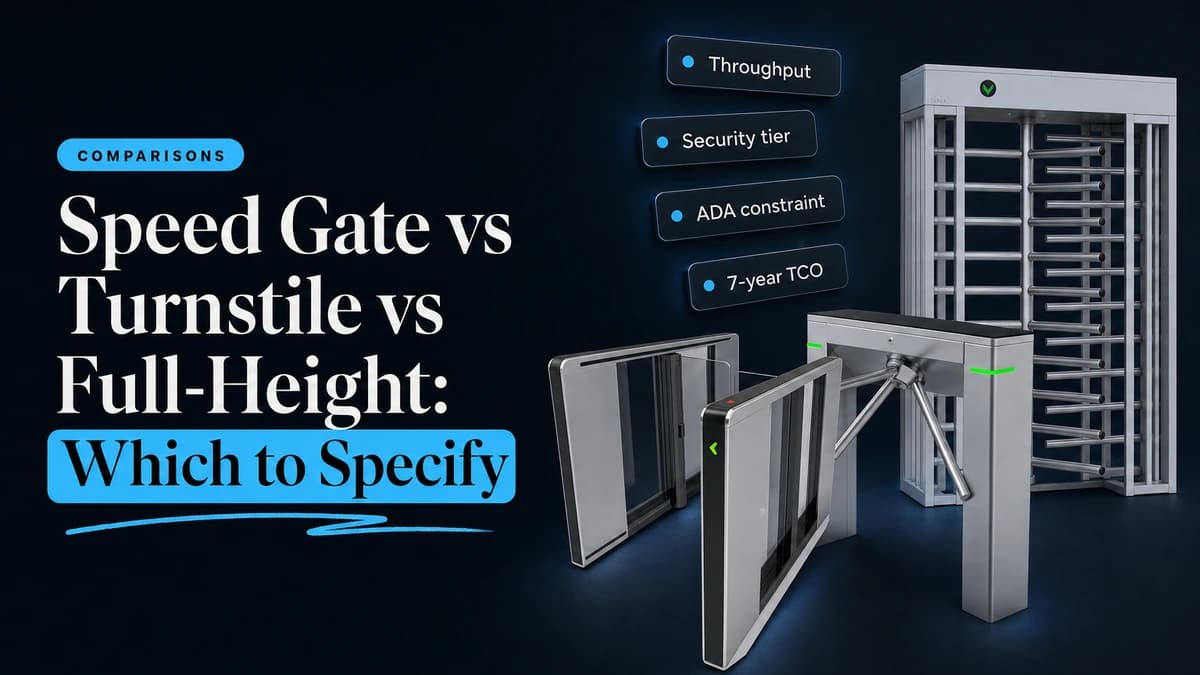
Speed Gate vs Turnstile vs Full-Height: A US Specifier's Guide (2026)
The 2026 specifier's guide to speed gates vs tripod vs full-height turnstiles. Throughput, security tier, ADA and NFPA, vertical fit, and 7-year TCO.
Gatestile Engineering Team
Apr 29, 2026
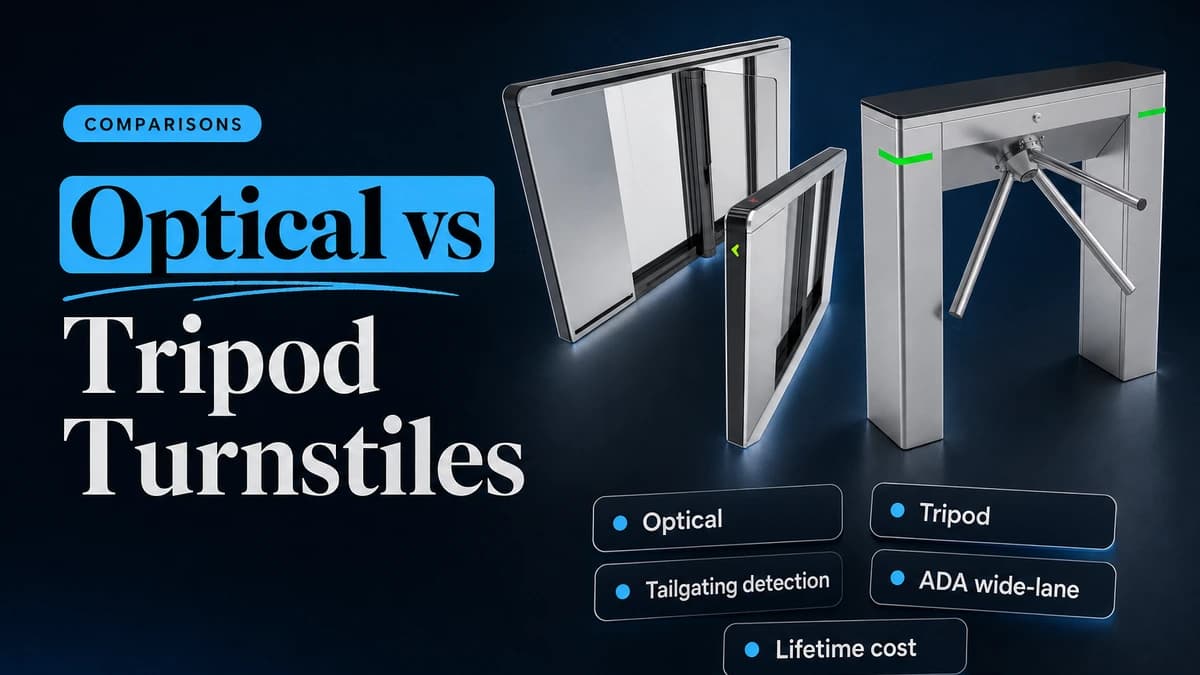
Optical Turnstile vs Tripod Turnstile: Which Belongs in Your Lobby
An 8-dimension head-to-head: optical speed gates vs tripod turnstiles. Tailgating, ADA, integrations (Lenel, Genetec, Honeywell), MTBF, and lifetime cost.
Gatestile Engineering Team
May 2, 2026
 New
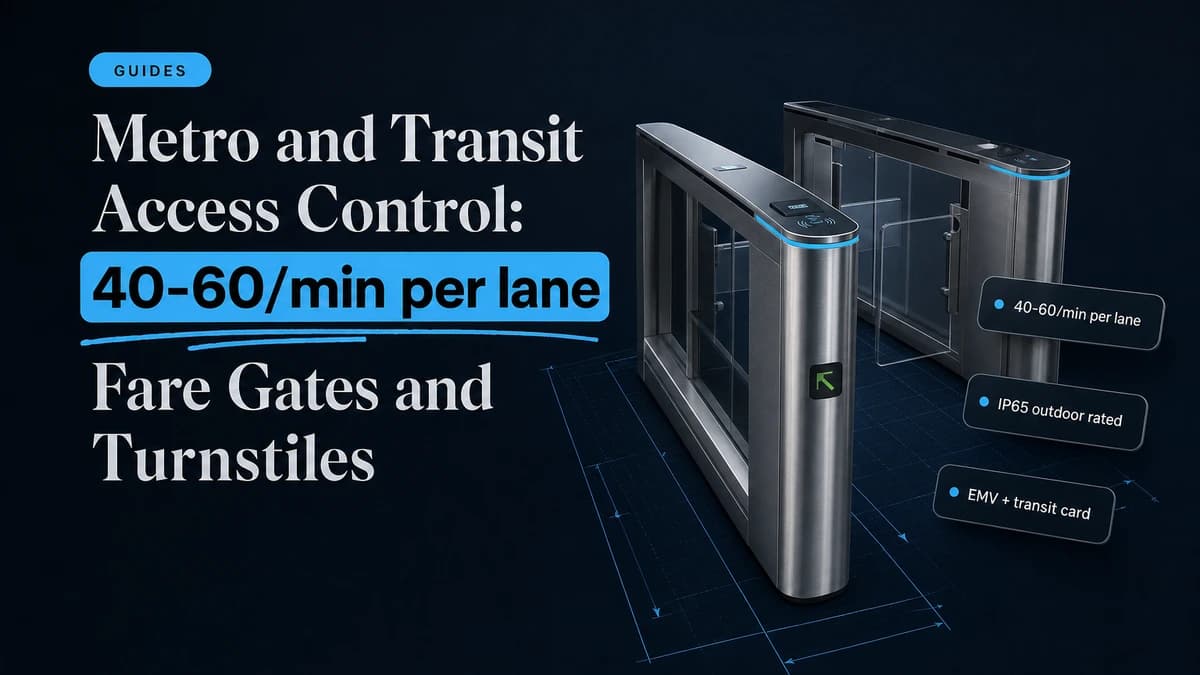
NewMetro and Transit Access Control: Fare Gates and Turnstiles
A buyer's guide to metro access control: how fare-gate turnstiles work, throughput, fare-system integration, ADA lanes, weatherproofing, and choosing.
Gatestile Engineering Team
Jul 27, 2026