

Guides
US Access Control Manufacturers: How to Choose the Right Category
Access control manufacturer searches cover two different vendor types. Learn the split, how they integrate, and which one your project actually needs.

Gatestile Engineering Team
Engineering & Specifications, Gatestile
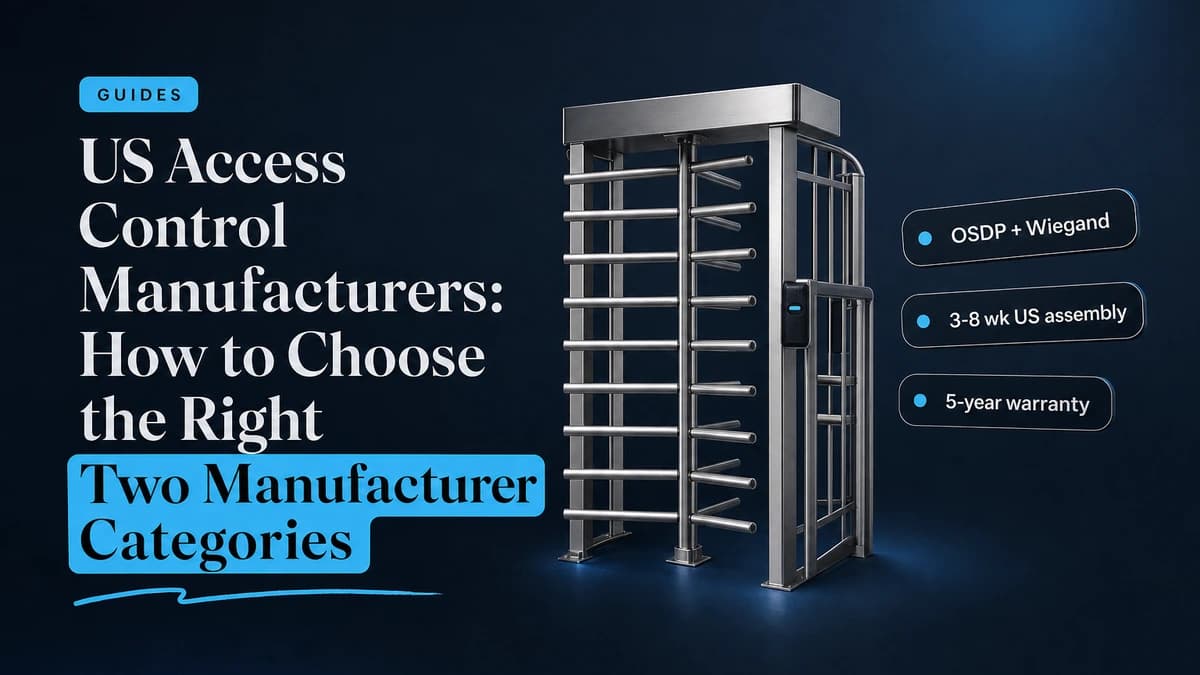
If you searched "access control manufacturer" expecting to find turnstile or gate vendors and landed on a listicle of credential and software companies instead, you are not reading the results wrong. The phrase genuinely means two different things depending on who is using it, and almost nothing published under that search term says so directly. This guide fills that gap: what each category actually builds, how they work together, and which one you need next.
What access control manufacturer actually covers
The phrase splits into two vendor categories that rarely appear on the same page, because they sell different products to different buyers.
An electronic access-control system manufacturer builds the layer that decides who is authorized: credentials (badges, mobile credentials, biometrics), readers, controllers, and the software or video management system (VMS) that ties them together. This is the category that currently occupies the search results for "access control manufacturer": companies like Lenel, Genetec, Honeywell, HID, and S2 are recognized names in this space. They do not manufacture the physical barrier a person walks through.
A physical entrance-control hardware manufacturer builds the barrier itself: turnstiles, speed gates, full-height turnstiles, and swing gates that stand at the entrance and physically release or block passage. This is Gatestile's category. This hardware does not make the authorization decision; it carries out whatever decision the electronic system already made.
| Category | What it provides | Who typically buys it | Named examples |
|---|---|---|---|
| Electronic access-control manufacturer | Credentials, readers, controllers, software/VMS that decide who is authorized | Security director, IT/security integrator specifying the head-end | Lenel, Genetec, Honeywell, HID, S2 |
| Physical entrance-control manufacturer | Turnstiles, speed gates, full-height turnstiles, swing gates that physically release or block passage | Facility manager, architect, general contractor specifying the lobby entrance | Gatestile, and comparable US and imported turnstile manufacturers |
Neither list is exhaustive, and naming a vendor here is not an endorsement or a claim about their specific products; it is context for which shelf each one sits on. The point that matters for your search: if your project needs both a credential system and a physical barrier, which most commercial entrances do, "access control manufacturer" alone will only surface half your vendor list.
How the two systems work together
The two categories are not competitors; they are stacked. The electronic access-control system makes the authorization decision, then hands that decision to the physical hardware over a standard reader-to-panel protocol, most commonly OSDP or Wiegand.
In practice, a badge tap at the reader goes to the access-control head-end (the Lenel, Genetec, Honeywell, or S2 software making the call), and the head-end's authorization signal travels back over OSDP or Wiegand to the turnstile or gate, which releases its arm, wing, or barrier for exactly one passage. The turnstile has no opinion about who the person is; it only executes the release signal it receives. That is why a physical entrance-control manufacturer worth shortlisting tests native OSDP and Wiegand support against the major head-ends before it ships hardware, rather than leaving that integration to be discovered on-site.
Which one do you need
Work from what you already have, not from the search term.
If you already have badge readers, credentials, and access-control software installed and the entrance itself is the gap, an open door, an unstaffed lobby, a turnstile that is failing or undersized, you need a physical entrance-control manufacturer. The electronic decision layer is solved; you need hardware that will carry out that decision reliably at the door.
If you need the credential and software layer itself, badges or mobile credentials, readers, the controller, the software or VMS that makes the authorization call, you need an electronic access-control system manufacturer. This is the case for a new building with no access-control system at all, or a security-system-wide upgrade that touches every door, not just the lobby.
Many projects need both, specified as two separate line items from two separate manufacturers that integrate over OSDP or Wiegand, not one manufacturer that does everything. That split is normal in this industry and not a sign either vendor is incomplete.
Choosing a physical entrance-hardware manufacturer
If your gap is the physical hardware, the evaluation looks different from picking a software vendor. "US manufacturer" for entrance hardware specifically means domestic assembly with a shorter, more predictable lead time: US-assembled turnstiles and gates commonly ship in 3 to 8 weeks, against 10 to 16 weeks for fully imported equivalents, plus faster access to domestic spare parts if a unit needs service. A US manufacturer should also carry a clearly scoped multi-year hardware warranty (5 years on motors, electronics, sensors, and metalwork is a strong commercial benchmark) and be able to hand you ISO 9001, UL-listed component, and ADA-compliant-configuration documentation on request.
That summary is deliberately brief, because we have already published the full seven-factor scorecard: lead time, warranty scope, certifications, domestic-vs-imported assembly, integration support, spares and service reach, and published specs, each with what a strong answer and a weak answer look like, plus how Gatestile scores on the same checklist. Read the full turnstile manufacturer evaluation checklist before you shortlist a physical-hardware vendor; it is the deeper reference this article routes to.
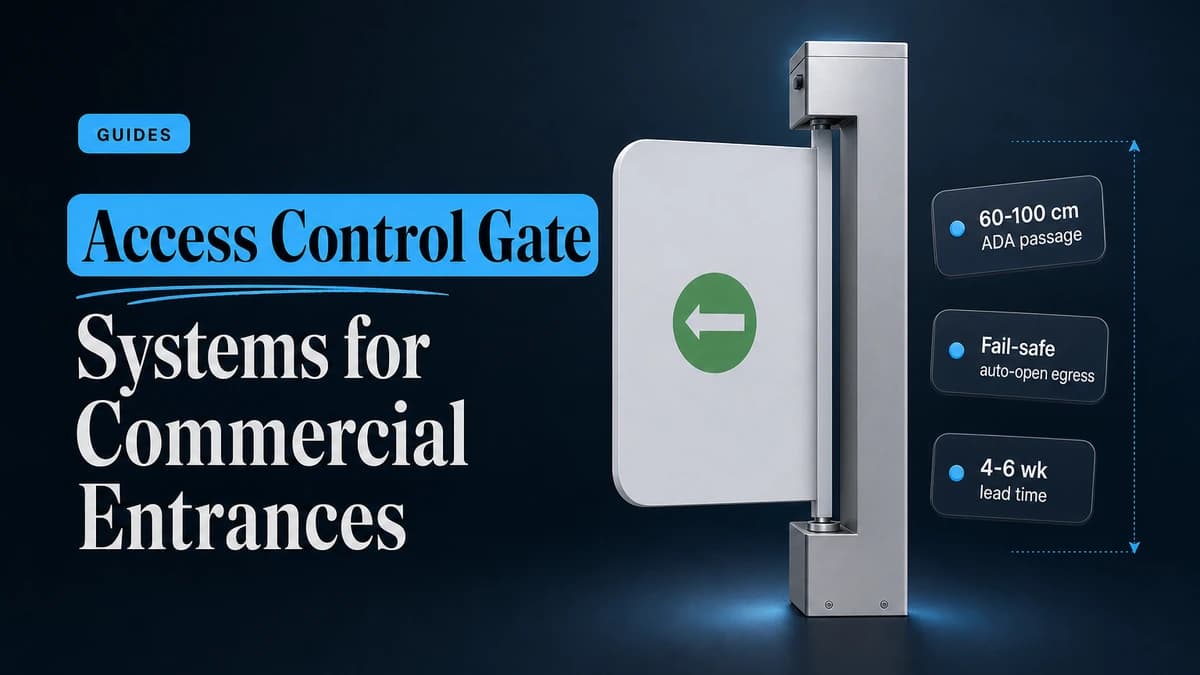
If you are pairing that hardware with an ADA-width lane, the access control gate systems guide covers the swing-gate side of the same lane row, and if budget is the next question, the 2026 commercial turnstile cost guide breaks down price bands by product line.
Frequently asked questions
- The phrase covers two different vendor categories. An electronic access-control manufacturer builds the credentials, readers, and software or VMS that decide who is authorized (brands like Lenel, Genetec, Honeywell, HID, or S2). A physical entrance-control manufacturer builds the turnstiles, gates, and barriers that physically stop or release a person, and that hardware obeys the electronic system's decision over OSDP or Wiegand.
Keep reading
 New
NewHow to Choose a Commercial Turnstile Manufacturer (2026 Buyer's Checklist)
A vendor-neutral checklist for evaluating commercial turnstile manufacturers in 2026: lead times, warranty, certifications, US vs imported, and integration support.
Gatestile Engineering Team
Jul 22, 2026
 New
NewAccess Control Gate Systems for Commercial Entrances
A buyer's guide to access control gates for commercial lobbies: ADA pedestrian swing gates paired with turnstile or speed gate arrays, specs, and lead times.
Gatestile Engineering Team
Jul 25, 2026
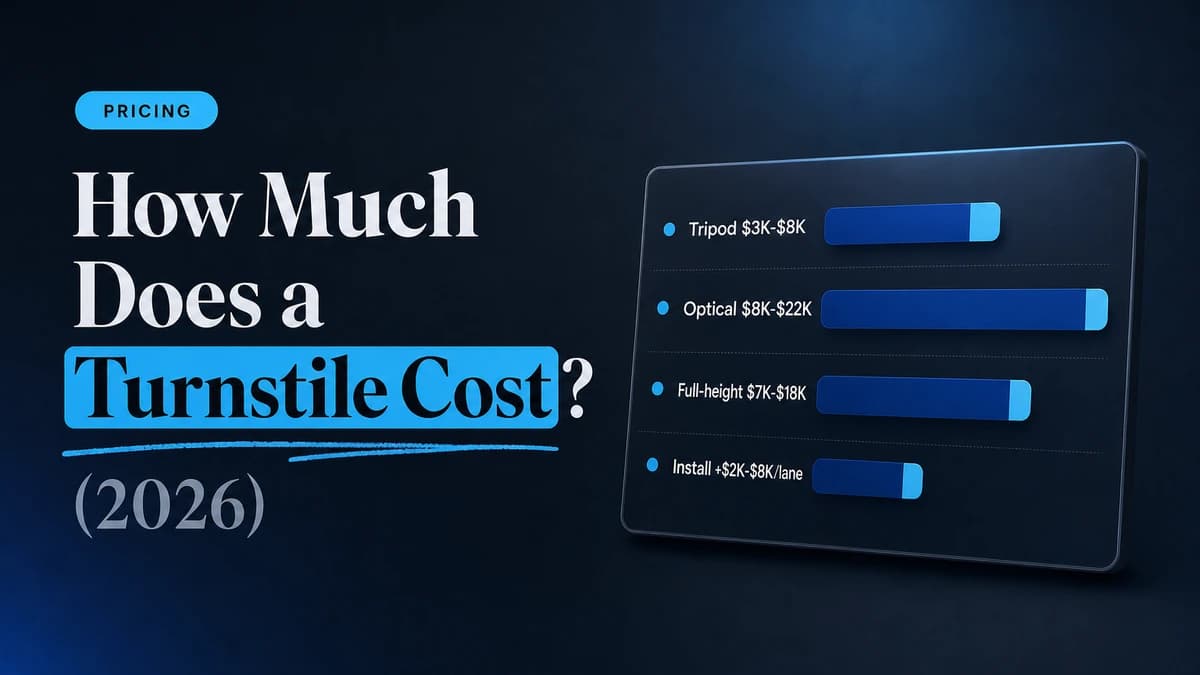
How Much Does a Commercial Turnstile Cost in the US? (2026 Real Price Bands + Installed-Cost Breakdown)
A 2026 cost guide for commercial turnstiles in the US. Real hardware bands, transparent installed-cost line items, lead times, and 5-year TCO. No fluff.
Gatestile Engineering Team
May 6, 2026