

Comparisons
Speed Gate vs Turnstile vs Full-Height: A US Specifier's Guide (2026)
The 2026 specifier's guide to speed gates vs tripod vs full-height turnstiles. Throughput, security tier, ADA and NFPA, vertical fit, and 7-year TCO.

Gatestile Engineering Team
Engineering & Specifications, Gatestile
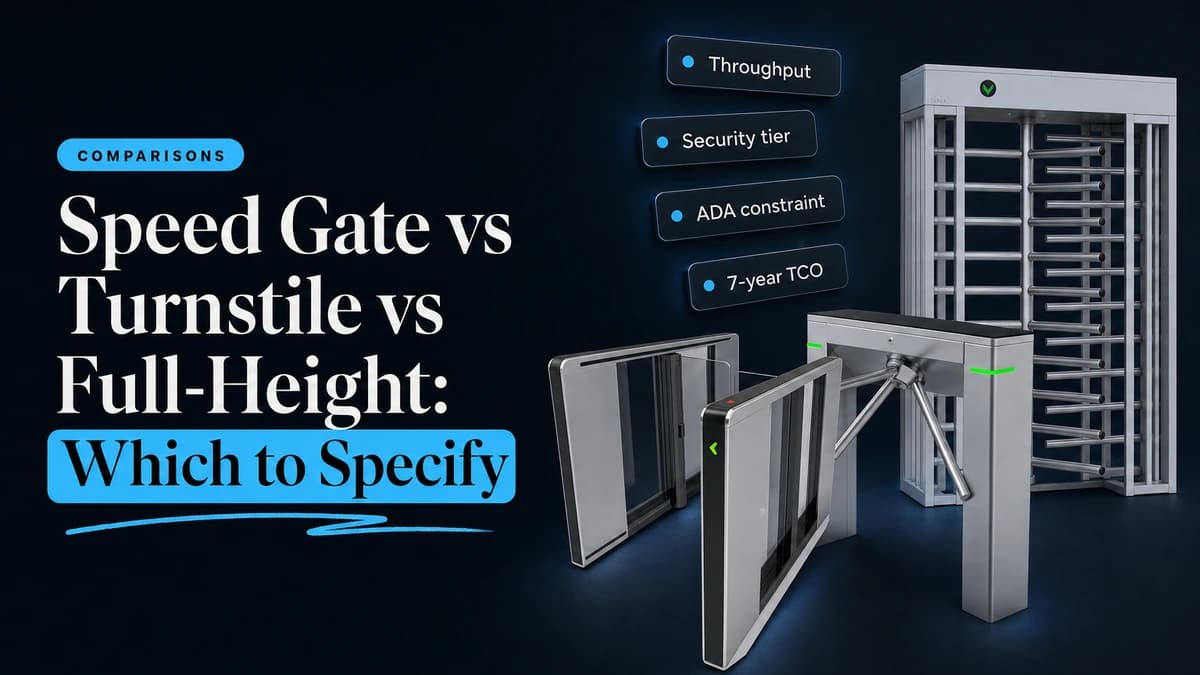
Pricing, throughput, and lead-time figures in this guide are current as of July 2026.
If you're spec'ing a turnstile lane for a US commercial project in 2026, you're picking between three product classes. This guide is the framework we walk every architect, facility manager, and integrator through before they request a quote.
The short version: pick by throughput, security tier, and ADA constraint, in that order. Aesthetics matters but it's the last variable, not the first. Cost is a constraint, not a driver.
The three product classes, in plain English
There are seven distinct turnstile product lines on the modern US market. They fall into three functional classes:
| Class | Product lines | Where they live | Primary job |
|---|---|---|---|
| Optical (speed gate) | Single-lane optical, dual-lane optical, glass rotating | Lobbies, concourses, finance/data center mantraps | Aesthetic detection: speed + tailgating + ADA wide-lane |
| Mechanical (low to mid height) | Tripod, three-quarter height, swing gate (ADA companion) | Gyms, transit, Class C office, schools, religious facilities | Cost-effective controlled passage |
| Mechanical (full height) | Full-height turnstile, sanitary barrier | Perimeter fences, parking decks, stadiums, healthcare, food processing | Hard physical barrier: climb-over and walk-around proof |
The mental model: optical units detect a passage and use barriers to stop the unauthorized; mechanical units physically restrict a passage with arms or rotors. That distinction drives almost every other decision.
Throughput, measured
This is where most spec sheets lie. Manufacturers publish "up to" numbers from lab conditions: single trained operator, no credential read time, perfect IR detection. Real-world throughput in a busy 8 AM lobby is 60–80% of the lab number.
| Product class | Lab rate (mfg published) | Realistic peak rate | Notes |
|---|---|---|---|
| Single-lane optical speed gate | 30–60 ppm | 25–35 ppm | Bottleneck is credential read time |
| Tripod turnstile | 30 ppm | 20–28 ppm | Hesitation at arm + reader read |
| Three-quarter height | 25 ppm | 18–22 ppm | Slightly slower than tripod |
| Full-height turnstile | 12–20 ppm | 10–15 ppm | Rotor cycle dominates |
| Glass rotating (mantrap) | 15–20 ppm | 10–14 ppm | Sequential single-occupancy |
| Swing gate (ADA wide) | 10–18 ppm | 8–12 ppm | Wide passage = slower close |
How to use these numbers: divide your peak-hour expected traffic by the realistic peak rate to get lane count. A Class A office with 1,200 occupants arriving in a 30-minute peak window needs roughly 40 ppm of total throughput: that's two optical speed gate lanes plus an ADA companion, not one.
If you're spec'ing for a stadium, transit hub, or any high-volume venue, build to the lab rate × 0.6 and add 20% lane redundancy. Lanes go down for service.
Security tier: tailgating risk and physical barrier
The other axis. Two units can have the same throughput and very different security profiles.
| Product class | Tailgating prevention | Climb-over | Force resistance | Mantrap fit |
|---|---|---|---|---|
| Glass rotating | Excellent (sequential single-pass) | N/A (closed) | Excellent | Native |
| Optical speed gate | Good (IR + 3D sensors) | Easy (low barrier) | Limited (glass) | Pair with mantrap |
| Full-height turnstile | Excellent (full rotor) | Impossible | Excellent | Native |
| Three-quarter height | Good (taller rotor) | Difficult | Strong | OK |
| Tripod turnstile | Limited (arm-jump or duck-under) | Easy | Limited | Poor |
| Swing gate (ADA) | Limited (wide passage) | Easy | Limited | Poor |
The decision: if your threat model includes a determined unauthorized person, you need a full-height turnstile or a glass rotating mantrap. Optical speed gates and tripods are designed to deter casual tailgating in environments where social pressure (front-desk, security guard) handles the rest.
If your threat model is a tenant who tailgates a visitor in by accident, an optical speed gate with proper IR/3D detection handles it. The barrier-rises-on-violation behavior plus an audible alert is enough.
If your threat model is a transit-fare evader or a stadium fence-jumper, you want a full-height turnstile. Period.
ADA and NFPA 101 implications
Code-driven, mandatory, and the most commonly missed item in early spec.
The practical translation: every turnstile lane bank in a US commercial deployment needs at least one wide-lane passage, and every motorized barrier needs a fire-alarm retract function. Plan both from day one: retrofitting either is significantly more expensive than spec'ing it correctly.
Vertical fit: which class wins where
The matrix that maps US verticals to the right product class. Most projects don't think about fit until they're already over-spec'd or under-spec'd.
| Dimension | Optical speed gate | Tripod / 3-quarter | Full-height | Glass rotating |
|---|---|---|---|---|
| Class A office lobby | Best | Weak | Weak | Good |
| Class C office / back-of-house | Good | Best | Adequate | Weak |
| Data center / finance mantrap | Good | Weak | Good | Best |
| Stadium / arena | Adequate | Good | Best | Weak |
| Transit / parking | Adequate | Good | Best | Weak |
| Gym / recreation | Good | Best | Weak | Weak |
| Healthcare (clinical wing) | Best | Adequate | Weak | Good |
| Food processing / pharmaSanitary barrier (full-height variant) is the right SKU here | Weak | Good | Best | Weak |
| School / university | Good | Best | Adequate | Weak |
| Religious facility (mikveh) | Weak | Best | Good | Weak |
The matrix isn't gospel, since site-specific factors like ceiling height, slab condition, available power, and AHJ relationships move things, but it's a starting point. If your spec lands on a "weak" cell, ask twice why.
7-year TCO snapshot
Hardware sticker is one number. Year-zero installed cost adds 25–60%. Year-1-through-7 service, parts, and downtime add another 20–35%. Here's the ratio that holds across product classes:
| Product class | Year-0 installed | Years 1–7 service | 7-year TCO |
|---|---|---|---|
| Tripod turnstile | $8,500 | $3,200 | $11,700 |
| Three-quarter height | $13,500 | $4,500 | $18,000 |
| Full-height turnstile | $16,500 | $5,800 | $22,300 |
| Optical speed gate | $21,000 | $7,200 | $28,200 |
| Glass rotating | $48,000 | $13,500 | $61,500 |
For deeper detail on these numbers, including the specific install line items and what drives service cost up or down, see our 2026 turnstile pricing breakdown.
The mistake we see most often in submitted specs: teams size for the daily 9-to-5 average when the project actually needs to handle the 8:45 AM peak. Build for peak and you avoid the panic retrofit two years in.
The 90-second decision tree
If you only have 90 seconds before a stakeholder meeting, run this:
- Indoor or outdoor? Outdoor → full-height (IP65). Indoor → continue.
- Class A lobby aesthetic required? Yes → optical speed gate. No → continue.
- Throughput requirement > 25 ppm/lane realistic? Yes → optical speed gate or tripod (high-volume tripod is fine). No → continue.
- Threat model includes determined unauthorized? Yes → glass rotating (mantrap) or full-height. No → tripod is acceptable.
- Wide-lane ADA passage required at this entry? (Almost always yes.) → Pair with an ADA companion: swing gate or wide-lane optical.
- Fire-alarm retract function required? (Yes, in nearly every US occupancy.) → Spec at order time, not as a retrofit.
That's the framework. The matrix above tells you which class fits which vertical. The throughput and TCO tables tell you how many lanes and how much it costs over the life of the deployment.
If you're at the next step, comparing optical speed gates against each other on the detail level, read our optical vs tripod turnstile guide. If you're already at the budget stage, the 2026 pricing breakdown is the next stop. If your shortlist already includes a specific manufacturer, our Boon Edam alternatives comparison breaks down published specs against that manufacturer by product class.
Frequently asked questions
- A speed gate is a type of optical turnstile that uses motorized barriers (typically tempered or laminated glass panels) and an array of infrared and 3D sensors to detect a single authorized passage and stop tailgaters. A traditional turnstile uses a mechanical arm: three arms on a tripod or a full rotor on a full-height unit. Speed gates are the Class A office and modern commercial standard. Mechanical turnstiles remain the standard for industrial perimeters, transit, and budget-sensitive deployments.
Keep reading
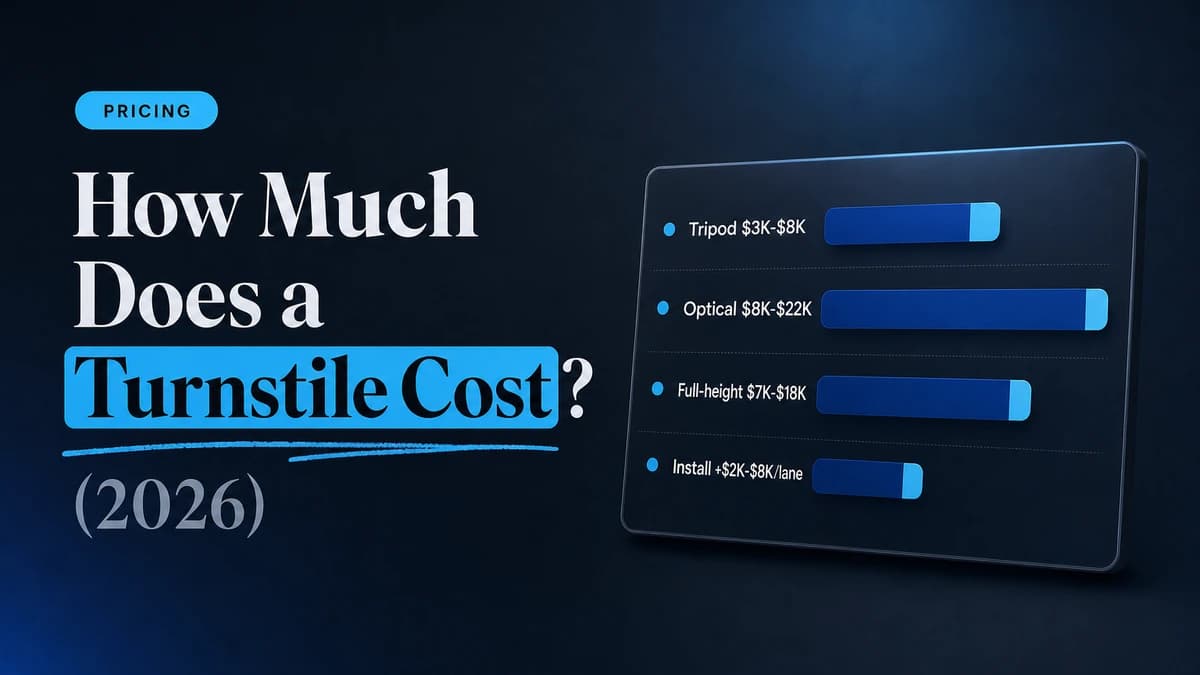
How Much Does a Commercial Turnstile Cost in the US? (2026 Real Price Bands + Installed-Cost Breakdown)
A 2026 cost guide for commercial turnstiles in the US. Real hardware bands, transparent installed-cost line items, lead times, and 5-year TCO. No fluff.
Gatestile Engineering Team
May 6, 2026
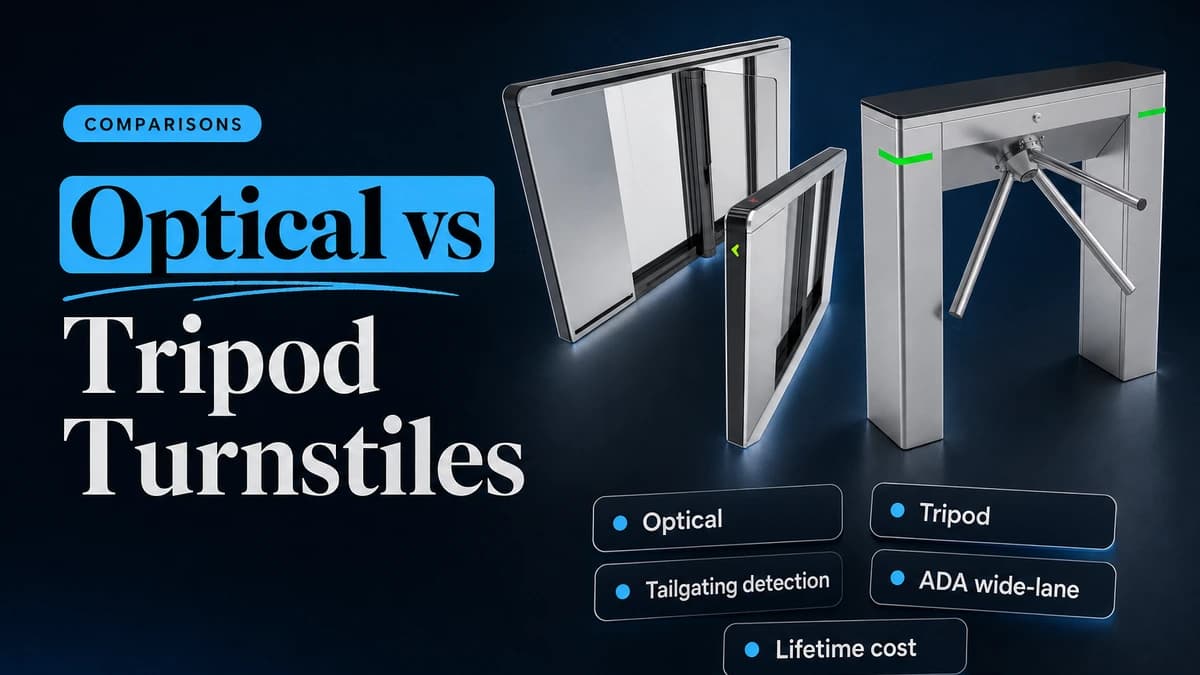
Optical Turnstile vs Tripod Turnstile: Which Belongs in Your Lobby
An 8-dimension head-to-head: optical speed gates vs tripod turnstiles. Tailgating, ADA, integrations (Lenel, Genetec, Honeywell), MTBF, and lifetime cost.
Gatestile Engineering Team
May 2, 2026
 New
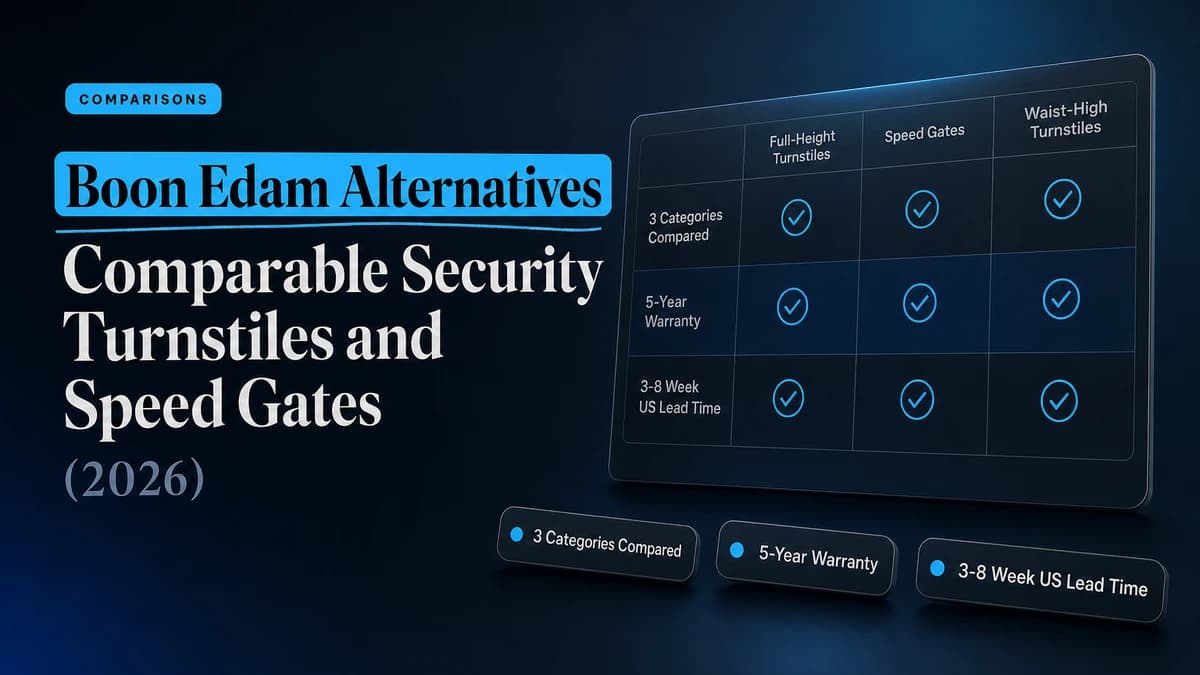
NewBoon Edam Alternatives: Comparable Security Turnstiles and Speed Gates (2026)
Boon Edam alternatives compared by category, speed gates, tripod turnstiles, and full-height units, with published specs, real lead times, and honest fit guidance.
Gatestile Engineering Team
Jul 30, 2026