

Guides
Data Center Turnstiles: A Physical Security Buyer's Guide
How data center facility managers spec turnstiles for mantrap entries, tailgating prevention, and colocation vs enterprise access control needs.

Gatestile Engineering Team
Engineering & Specifications, Gatestile
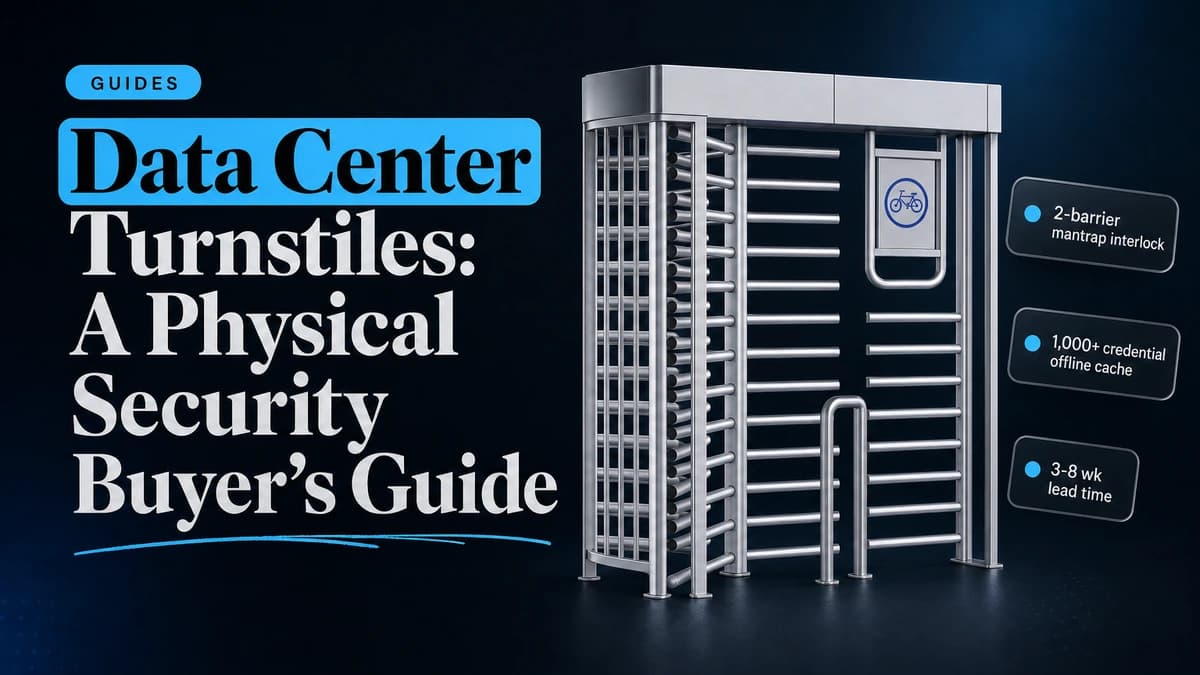
Data center entrances are rarely a single doorway decision. Most facilities stack two or three tiers of physical access control between the parking lot and the server room, and each tier answers a different question: who gets on the property, who gets into the white space, and who gets into a specific cage or cabinet row. Getting the hardware wrong at any tier either creates a security gap or a throughput bottleneck your operations team will fight every shift change.
This guide walks through how to think about turnstile selection for data center security: the mantrap model, tailgating prevention mechanics, how colocation and enterprise facilities differ in what they need, and where each Gatestile product line fits.
Data center entrances live or die on integration. Pair this with the access control integration guide for reader and head-end wiring, and the full-height turnstile buyer's guide for the perimeter tier.
The layered-entry model
Data center physical security is built in layers, not a single gate. A typical layout looks like this:
| Tier | What it controls | Typical hardware | Primary risk it addresses |
|---|---|---|---|
| Perimeter / building entry | Who gets onto the site or into the building | Full-height turnstiles | Climbing, crawling, unauthorized after-hours entry |
| Staff and visitor lobby | Badge-in flow for employees and escorted visitors | Optical speed gates | Tailgating on a valid badge, visitor logging |
| White space / server room | Who enters the raised floor or server hall | Mantrap (interlocked doors or glass rotating turnstile) | Piggybacking, unverified single-person passage |
| Cage / cabinet row (colocation) | Per-tenant isolation within shared white space | Mantrap or interlocked gate, tenant-specific credentials | Cross-tenant access, unauthorized cage entry |
Not every facility needs all four tiers at full hardening. A single-tenant enterprise data center might combine the perimeter and lobby tier into one full-height turnstile line and reserve the mantrap for the white-space door alone. Our Full-Height Turnstile Buyer's Guide covers general specification of that line in more depth. A colocation facility with dozens of tenants usually cannot skip the cage tier, since isolating each customer's footprint is the whole business model.
If your perimeter spec calls for a documented burglar-resistance class in addition to anti-climb geometry, our dormakaba alternatives comparison covers the optional RC2 rating on dormakaba's own Kentaur line alongside Gatestile's full-height options, useful context when a data center RFP asks for a specific resistance classification rather than a generic "vandal-resistant" claim.
How a mantrap actually works
A mantrap is two interlocked barriers, either doors or turnstiles, where the first must fully close before the second will open. Only one verified person is ever inside the space between them. The mechanism, not the marketing term, is what matters when you are specifying one:
The interlock logic itself is straightforward: the outer barrier locks the moment it closes, and the inner barrier will not release until the control system confirms the space between them holds exactly one verified person. Systems built for this application add weight sensors and occupancy detection in the vestibule to catch a case where two people entered on one badge before the outer door fully closed.
For zones where policy requires two specific people present together rather than just one verified person, the same interlock logic can be configured to hold the barrier until two distinct credentials present within a set window. That is a configuration of the mantrap control logic, not a different piece of hardware.
Our glass rotating turnstiles are built around this mantrap logic natively: a fully enclosed rotating drum with interlocking door sequences, 10 mm tempered safety glass, and biometric integration points, so the next person cannot enter until the current occupant has fully exited. For facilities that prefer a door-based mantrap instead of a rotating enclosure, the same interlock principle applies to a pair of standard access-controlled doors, with the turnstile vendor supplying only the control logic and sensors, not the doors themselves.
Tailgating and piggybacking: where each product line stops it
"Tailgating" and "piggybacking" get used interchangeably, but the distinction matters for hardware selection: tailgating is an unauthorized person following an authorized one through without presenting credentials, piggybacking is when the authorized person deliberately lets them in. Neither is solved by a badge reader alone, since a reader only confirms a valid credential was presented, not how many bodies came through after it.
| Dimension | Full-height turnstiles | Speed gates | Mantrap (glass rotating) |
|---|---|---|---|
| Physical prevention of a second person passingFull-height and mantrap enclosures physically block a second body; speed gates rely on sensor detection and alarm, not a hard barrier. | Best | Adequate | Best |
| Throughput for staff shift changesSpeed gates are built for volume; full-height single-lane passage is slower by design; mantraps intentionally single-thread traffic. | Adequate | Best | Weak |
| Suitable for white space / cage entryWhite space entries need verified single-person passage, which is the mantrap's specific job. | Weak | Adequate | Best |
| Outdoor perimeter dutyFull-height turnstiles are rated for continuous outdoor use; speed gates and glass mantraps are indoor/sheltered hardware. | Best | Weak | Weak |
For the lobby and staff-badge tier specifically, our Lumen Edge speed gate is built with up to 24 optical safety sensors and an IP54 cabinet, giving it the densest tailgate-detection coverage in the speed gate line, along with RS-485, RS-232, CAN bus, and TCP/IP integration options for connecting to existing access-control panels. At the perimeter, our Bastion full-height turnstile is the most reinforced model in the lineup at roughly 1,080 lb (490 kg), with an integrated low-profile gate beside the rotor for oversized loads or accessible passage, useful where a perimeter line also needs an occasional cart or equipment path next to the turnstile lane.
Colocation vs enterprise data centers: different entry problems
A single-tenant enterprise data center and a multi-tenant colocation facility are solving different access problems, even though both say "data center" on the building sign.
- Enterprise (single-tenant): Every person past the lobby is presumed to belong to one organization. Hardening concentrates at fewer choke points, typically the perimeter and the white-space door, since there is no need to separate one customer's traffic from another's inside the building.
- Colocation (multi-tenant): Visitors, customer engineers, and multiple tenants' staff move through the same lobby daily, so the lobby tier needs faster, higher-volume throughput and visitor-logging discipline. Past the white-space door, cage- or row-level mantraps become necessary rather than optional, since the operator has to prove one tenant's staff cannot wander into another tenant's cage.
That difference changes the lead-time and configuration conversation. A colocation buyer is often specifying a lobby speed-gate line plus multiple smaller cage interlocks in the same order, while an enterprise buyer may need only a perimeter turnstile run and a single white-space mantrap.
Integration and offline behavior
A turnstile that cannot talk to the rest of the security stack is a manual gate with extra steps. For data center deployments specifically, two integration behaviors matter more than they do in a typical office lobby:
Systems designed for this kind of deployment cache recent credentials locally and continue validating offline, logging every event for replay once the connection to the panel restores. That single behavior is often the difference between a documented, defensible audit trail during a network incident and a blind spot in your logs.
What this costs and how long it takes
Lead time is the number that most often blows up a data center construction or fit-out schedule, since entrance control tends to be ordered late and installed early relative to other trades.
| Product line | Typical lead time | Notes |
|---|---|---|
| Full-height turnstiles | 6-8 weeks | Outdoor variants and 316-grade stainless add about 2 weeks |
| Speed gates | 4-6 weeks | Custom finishes add 2-3 weeks |
| Glass rotating (mantrap) | 8-10 weeks | Custom configurations run 12-14 weeks |
The site-wide range across all lines is 3 to 8 weeks; the mantrap-capable glass rotating line runs longer than that range because of its enclosure fabrication and interlock logic testing. Order entrance control as soon as your floor plan and door schedule are locked, not after the raised floor is in.
Frequently asked questions
- Most data centers layer two types: full-height turnstiles at the outer perimeter for anti-climb deterrence, and a mantrap configuration (interlocked doors or a glass rotating turnstile) at the server-room or cage entrance for single-person verification. Speed gates are common at staff and visitor lobbies where throughput matters more than a hard barrier. The right mix depends on how many security tiers your facility design calls for.
Keep reading
 New
NewFull-Height Turnstile Buyer's Guide (2026)
A specifier's guide to full-height turnstiles: Gatestile's seven models, shared platform specs, ADA companion-lane rules, egress, site prep, and lead times.
Gatestile Engineering Team
Jul 18, 2026
The Turnstile Access Control Integration Guide (2026)
How turnstiles and speed gates wire into HID, LenelS2, Genetec, and Honeywell: protocols, reader packages, REX, fire-alarm release, and anti-passback.
Gatestile Engineering Team
May 29, 2026
 New
NewDormakaba Turnstile Alternatives for US Facilities (2026)
Dormakaba turnstile alternatives compared by category, Kerberos, Charon, and Kentaur specs, US lead times, and dormakaba's own North American subsidiaries.
Gatestile Engineering Team
Aug 3, 2026