

Comparisons
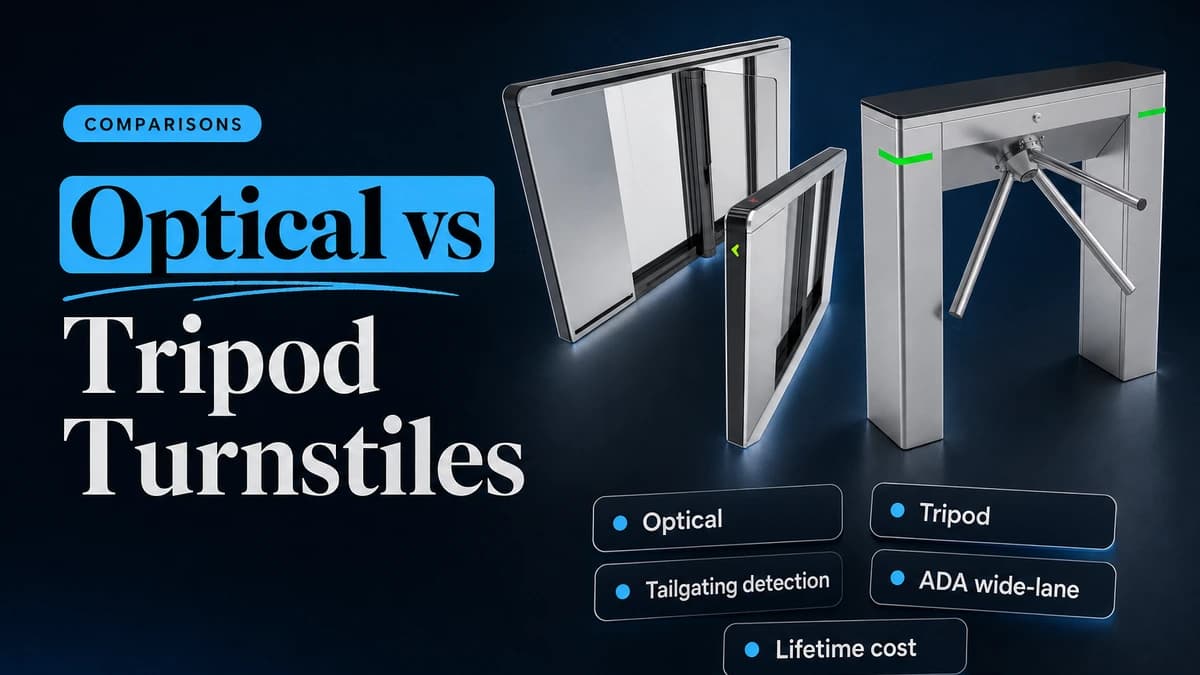
Optical Turnstile vs Tripod Turnstile: Which Belongs in Your Lobby
An 8-dimension head-to-head: optical speed gates vs tripod turnstiles. Tailgating, ADA, integrations (Lenel, Genetec, Honeywell), MTBF, and lifetime cost.

Gatestile Engineering Team
Engineering & Specifications, Gatestile
Figures and integration matrices in this guide are current as of July 2026. On the wire protocol, SIA's OSDP standard is the modern reference; it comes up in the integration dimension below.
This is a head-to-head. We're not picking a winner; we're picking the right one for your lobby. The 8-dimension matrix at the bottom is the single most extractable artifact in this post. If you're skimming, jump there.
Tailgating in numbers: how each detects, how each fails
The two products are designed against different threat models. That's the whole game.
Tripod turnstile: restricts, doesn't detect
A tripod turnstile is a mechanical product. Three arms at 120° rotate around a central column at waist height. An access-control read releases the arm clutch for a single rotation. There's no sensor array watching the lane: the unit can't tell whether one person or two passed through, only whether the arm rotated.
That gives you four practical tailgating failure modes:
- Tight tailgate. The unauthorized user follows the authorized user through during the same arm rotation. The arm doesn't know the difference.
- Duck-under. The arm is at waist height. A determined adult ducks under it; a kid walks under it.
- Jump-over. The arm is also a literal arm: adults can place a hand on it and vault over.
- Reverse direction abuse. Most tripods are unidirectional; the reverse direction can be configured but is often left as a manual-pass freewheel.
In a building with a manned front desk and social pressure, all four failure modes are visible and tend not to happen. In an unmanned lobby, all four happen weekly.
Optical speed gate: detects, then restricts
An optical speed gate is fundamentally a sensor product. Inside the cabinet there's an IR detection array (typically 8–24 photocells along the lane) and increasingly a 3D depth sensor (some manufacturers use stereo vision, others use single-point ToF). The system tracks every body that enters the lane and decides whether the count of entries matches the count of authorized credential reads.
Failure modes are different and rarer:
- Sub-detection size. A small object (carry-on bag held low) can defeat lower-end IR-only systems. 3D systems are immune.
- Same-stride coupling. Two people walking in extremely tight lockstep can register as a single signature on lower-end systems. 3D systems detect this too.
- Climb-over. The barrier height is 1.0–1.2 m on speed gates. Determined climb-over is possible but visible, slow, and triggers an alarm.
The hardware delta is large. The detection difference is bigger than the price difference.
Detection mechanism: IR array and 3D sensors vs mechanical arm
Quick technical breakdown of what's actually inside each product.
| Component | Optical speed gate | Tripod turnstile |
|---|---|---|
| Primary sensor | 8–24 IR photocells along lane + optional 3D depth sensor | Hall-effect rotation sensor on arm hub |
| Detection logic | Onboard MCU runs presence-counting algorithm; matches body count to credential reads | Simple state machine: read OK → release clutch → arm rotates → reset |
| Barrier | 10mm tempered glass or polycarbonate, motorized open/close | Three steel arms with rubberized tips, mechanical clutch |
| Motor | Brushless DC + planetary gearbox (premium); brushed DC (entry) | Solenoid clutch (no motor on arm); often brushed DC for reset |
| Failsafe (alarm + free-pass on power loss) | Yes: barrier drops open on alarm and on power loss | Yes: clutch releases on power loss; free-pass |
| Tailgating alarm | Built-in audible + relay output to ACS for log entry | External (lobby PIR if you wire one) |
The architectural difference: optical speed gates are sensor products with motorized barriers; tripods are mechanical products with simple electronic clutches. The optical unit is a small embedded computer that happens to have a glass barrier. The tripod is a turnstile that happens to have a clutch.
That tells you most of what you need to know about reliability profiles, integration depth, and service cost.
ADA lane configurations
Mandatory in any US commercial deployment. Skip this and your project fails inspection.
| Product | Standard lane | ADA-compliant configuration |
|---|---|---|
| Optical speed gate (single) | 55–60 cm (22") | Specify ADA wide-lane variant: 900–915 mm (36") |
| Optical speed gate (wide-lane) | N/A | 90 cm (36"), single product covers ADA |
| Tripod turnstile | 55 cm (~22") | Pair with ADA swing gate at same control point |
| Three-quarter / full-height | 55 cm (~22") | Pair with ADA swing gate or wide swing |
The practical pattern in 2026 US deployments:
- A bank of three optical speed gates typically includes one wide-lane variant that doubles as the ADA passage.
- A bank of three tripods requires a fourth lane: an ADA swing gate. That's an extra $10K–$20K of hardware plus install.
This is the single biggest reason mid-traffic Class A and Class B office buildings end up at optical speed gates: the math works out to be cheaper once you include the ADA companion that tripods require but optical can absorb.
Integration breadth: what plugs into what
This is where projects get specified or de-specified. Both classes integrate with all major US access control head-ends; the question is how they integrate.
| Protocol | Optical speed gate | Tripod turnstile | Notes |
|---|---|---|---|
| Wiegand 26-bit (legacy) | Supported | Supported | Being phased out; secure only at the panel |
| OSDP (modern standard) | Native | Native | OSDPv2 is the right choice on new builds |
| TCP/IP (network-attached) | Native on premium | Available on mid/premium | Required for cloud-managed ACS like Genea, Verkada |
| BLE / NFC mobile credential | HID Origo, Apple Wallet, Google Wallet | Same: depends on reader, not turnstile | Reader is independent of turnstile class |
| Biometric (face / fingerprint) | Suprema, IDEMIA, Hanvon at factory | Available but less common | Factory integration adds 2–3 weeks lead |
| QR code (transit, events) | Top-mount or angle-mount scanner | Top-mount only | Common on transit tripods |
Head-end compatibility:
| Head-end | Optical speed gate | Tripod turnstile |
|---|---|---|
| Lenel OnGuard | Native (OSDP / Wiegand) | Native |
| Genetec Security Center | Native (OSDP / Wiegand / TCP/IP) | Native |
| Honeywell Pro-Watch | Native (OSDP / Wiegand) | Native |
| S2 NetBox / Lumeo | Native (OSDP / Wiegand) | Native |
| Verkada Command | TCP/IP via partner integrations | TCP/IP via partner integrations |
| Genea Cloud | TCP/IP / OSDP | TCP/IP / OSDP |
| OpenPath / Avigilon Alta | BLE reader + Wiegand backplane | BLE reader + Wiegand backplane |
The takeaway: from an integration breadth perspective, optical and tripod are essentially equivalent on the major US head-ends. The question isn't can it integrate, it's what reader package and what backplane protocol, and those are reader-side choices, not turnstile-class choices.
Aesthetics and lobby fit
The reason projects pick optical over tripod even when budget is tight is rarely security. It's aesthetics. The Class A lobby tells you the answer.
| Building class | Default choice | Why |
|---|---|---|
| Class A office (premium NYC, Boston, SF, Chicago) | Optical speed gate | Glass barriers, low-profile, brand-statement aesthetic |
| Class B office (suburban, mid-tier urban) | Optical speed gate (entry-tier) or tripod | Optical wins if budget allows; tripod is a defensible mid-tier |
| Class C office / industrial back-of-house | Tripod or three-quarter | Function over form; tripod is the right call |
| Data center / finance lobby | Optical + glass rotating mantrap | Tier the entry; optical at perimeter, mantrap at server hall |
| Healthcare clinical wing | Optical speed gate | Quiet operation, ADA-flexible, sanitary |
| Healthcare back-of-house | Tripod or sanitary barrier | Cost-effective; sanitary if washdown required |
| Transit hub | Tripod or full-height | Volume + outdoor IP65 → tripod or full-height; optical only on premium platforms |
| Stadium / arena | Tripod or full-height | Volume per dollar wins; optical reserved for VIP entries |
| Gym / recreation | Tripod | Member throughput at low cost |
| School / university (academic) | Tripod | Cost-effective for student volume |
If you're in doubt, walk the lobby with a stakeholder and ask: "Are people going to comment on the turnstile, or just walk through it?" Optical speed gates get noticed (positively, when done right). Tripods are invisible, which is the right call in a back-of-house.
Failure modes and MTBF
Both products fail. They fail differently.
| Failure | Optical speed gate | Tripod turnstile |
|---|---|---|
| IR / 3D sensor drift | Common at 5–7 years; recalibrate or replace array | N/A |
| Glass barrier damage | Possible from impact; replacement $400–$1,200 | N/A |
| Drive belt wear | Belt replacement at 5–10 years on premium | N/A on most tripods |
| Arm clutch wear | N/A | Common at 2–4 years on high-traffic sites |
| Bearing replacement | Rare on planetary gearbox premium units | Common at 2–3 years on brushed-motor units |
| Control board failure | Rare; replacement $300–$800 | Rarer; replacement $200–$500 |
| Power supply failure | Common across both classes; $80–$200 | Common; $80–$200 |
| Manufacturer-claimed MTBF | 5–10 million cycles (premium) | 1–3 million cycles (mid-tier) |
The honest read: optical speed gates have more components and more sophisticated failure modes, but premium optical hardware (brushless DC + planetary gearbox + OEM 3D sensors) outlives premium tripod hardware. Cheap optical hardware fails faster than cheap tripod hardware. Spend in the right tier of either class and the lifetime is similar.
When a manufacturer gives you a claimed MTBF, ask them for the cycle count assumptions. "5 million cycles" at a 50-cycles-per-day site is 270 years (irrelevant). "5 million cycles" at a 5,000-cycles-per-day stadium is 2.7 years (very relevant). The cycle is what matters.
The 8-dimension scoring rubric
If you remember one thing from this article, it should be this matrix. Scan it, score your project on each dimension, and the right product class falls out.
| Dimension | Optical speed gate | Tripod turnstile |
|---|---|---|
| Tailgating preventionOptical: IR + 3D sensors. Tripod: arm only. | Best | Weak |
| ADA flexibility (single-product wide-lane)Tripod requires a paired swing gate; optical can be wide-lane native. | Best | Weak |
| Real-world peak throughputOptical 25–35 ppm vs tripod 20–28 ppm; UX delta larger than ppm delta. | Best | Good |
| Hardware cost (lower = better)Optical $8K–$22K vs tripod $3K–$8K per lane. | Weak | Best |
| Aesthetics (Class A lobby fit) | Best | Weak |
| Integration breadthBoth support Lenel, Genetec, Honeywell, S2; optical adds richer alarm I/O. | Best | Good |
| False-alarm rate (lower = better)Tripod has near-zero false alarms (no detection); optical has tunable sensitivity. | Good | Best |
| Service cost / MTBF (premium hardware)Roughly equivalent at premium tier; cheap optical fails faster than cheap tripod. | Good | Good |
How to use the matrix on a real project: weight each dimension by importance (tailgating prevention is non-negotiable for a finance lobby; cost is non-negotiable for a 200-lane stadium retrofit). Sum the weighted scores. The product class that wins the weighted sum is your default choice.
When to pick which
If your project hits any of these, default to optical speed gate:
- Class A office lobby (any US tier-1 metro)
- Tailgating is part of the threat model (finance, legal, healthcare records)
- ADA passage is required at this entry point and you only have room for one product line
- You need TCP/IP for cloud-managed ACS (Genea, Verkada, OpenPath)
- Aesthetics matter: the lobby is the brand impression
If your project hits any of these, default to tripod turnstile:
- Hardware budget is the binding constraint (5+ lanes at < $50K total hardware)
- Site is back-of-house, industrial, or transit volume
- Manned front desk handles tailgating exceptions socially
- Outdoor or semi-outdoor and you don't need full-height (then it's a low-IP tripod with a weather-shroud)
- Religious facility, school, gym: high-volume, low-budget, manned
If you're truly torn (most projects aren't), run a hybrid: optical at the main entry, tripod at the secondary. We see it constantly on Class B office portfolios where the front-of-house budget can absorb optical and the back-of-house gets tripod.
If you want pricing depth on whichever class wins, our 2026 pricing breakdown is the next read. If you're earlier in the process and trying to pick between three classes (optical, tripod, full-height), start with the specifier guide. If you're comparing against a specific manufacturer's optical or tripod line, our Boon Edam alternatives comparison puts published specs side by side.
Frequently asked questions
- Tripod turnstiles offer limited tailgating prevention. The mechanical arm only blocks a single waist-height passage. A determined tailgater can duck under, jump over, or follow tightly behind an authorized user before the arm fully resets. They're effective at deterring casual unauthorized entry in environments with social pressure (a manned front desk, a security guard) but they're not a hardware solution to a tailgating threat. Optical speed gates with IR + 3D detection arrays are the right hardware choice when tailgating is the primary risk.
Keep reading
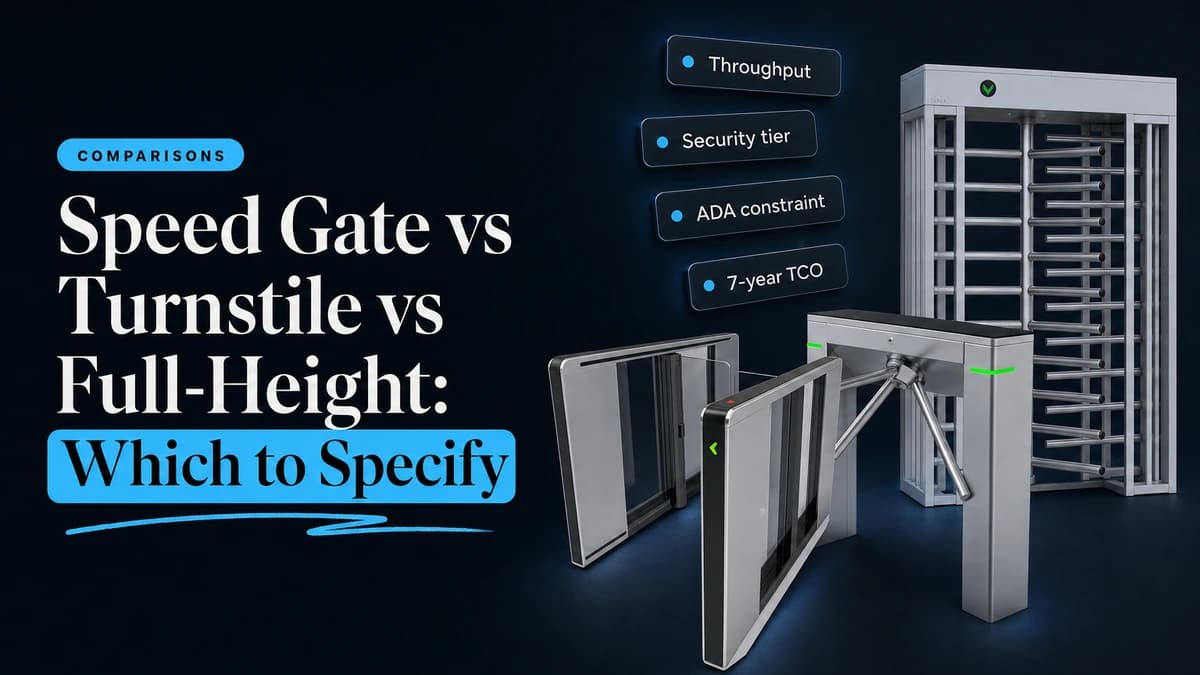
Speed Gate vs Turnstile vs Full-Height: A US Specifier's Guide (2026)
The 2026 specifier's guide to speed gates vs tripod vs full-height turnstiles. Throughput, security tier, ADA and NFPA, vertical fit, and 7-year TCO.
Gatestile Engineering Team
Apr 29, 2026
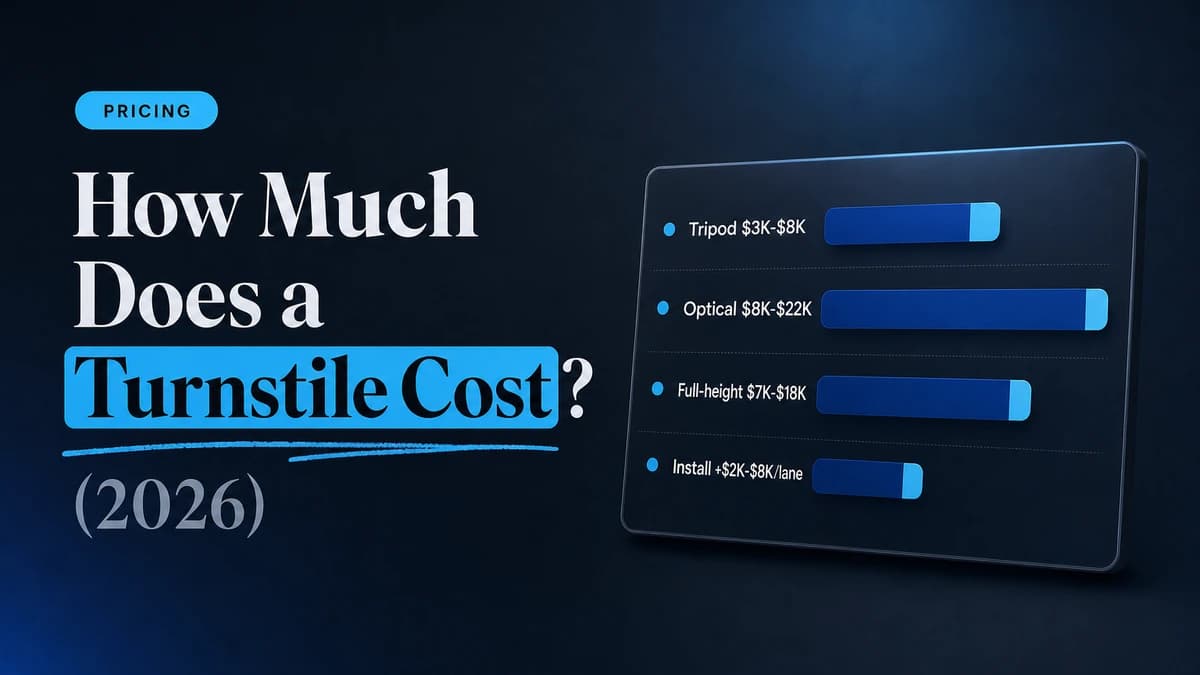
How Much Does a Commercial Turnstile Cost in the US? (2026 Real Price Bands + Installed-Cost Breakdown)
A 2026 cost guide for commercial turnstiles in the US. Real hardware bands, transparent installed-cost line items, lead times, and 5-year TCO. No fluff.
Gatestile Engineering Team
May 6, 2026
 New
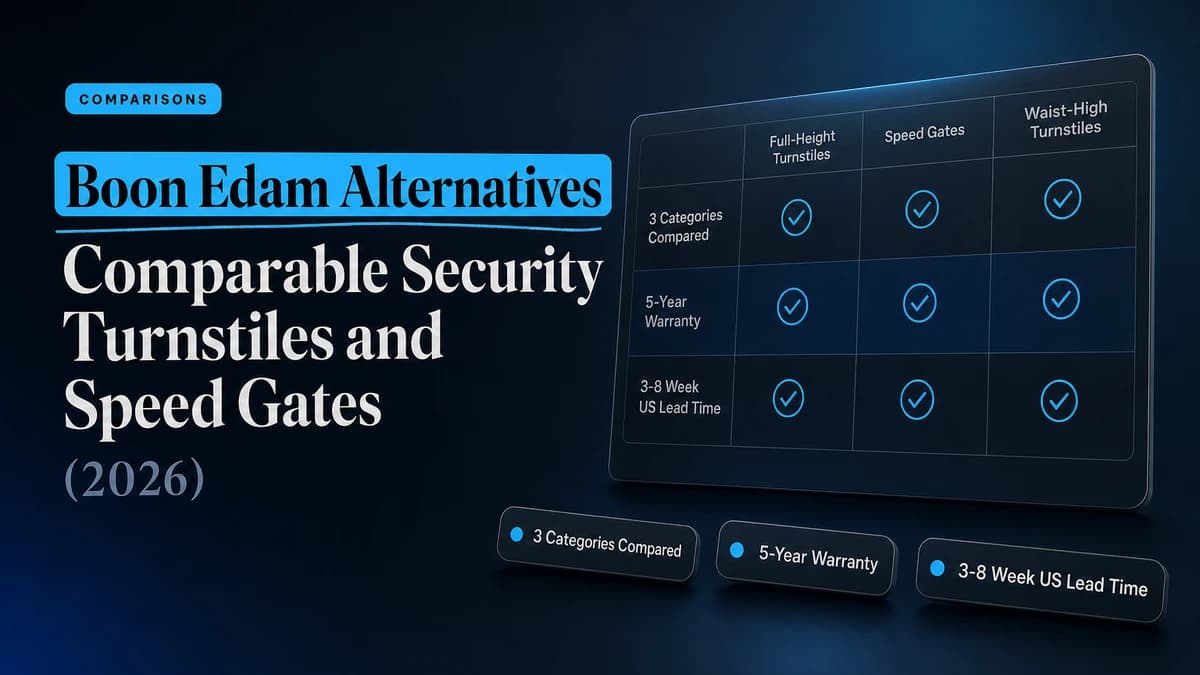
NewBoon Edam Alternatives: Comparable Security Turnstiles and Speed Gates (2026)
Boon Edam alternatives compared by category, speed gates, tripod turnstiles, and full-height units, with published specs, real lead times, and honest fit guidance.
Gatestile Engineering Team
Jul 30, 2026