

Guides
ADA Compliance for Entrance Control: A Specifier's Guide
How to keep a turnstile or speed gate install ADA compliant: the 32-inch rule, companion swing-gate lanes, force and timing, egress, and inspection failures.

Gatestile Engineering Team
Engineering & Specifications, Gatestile
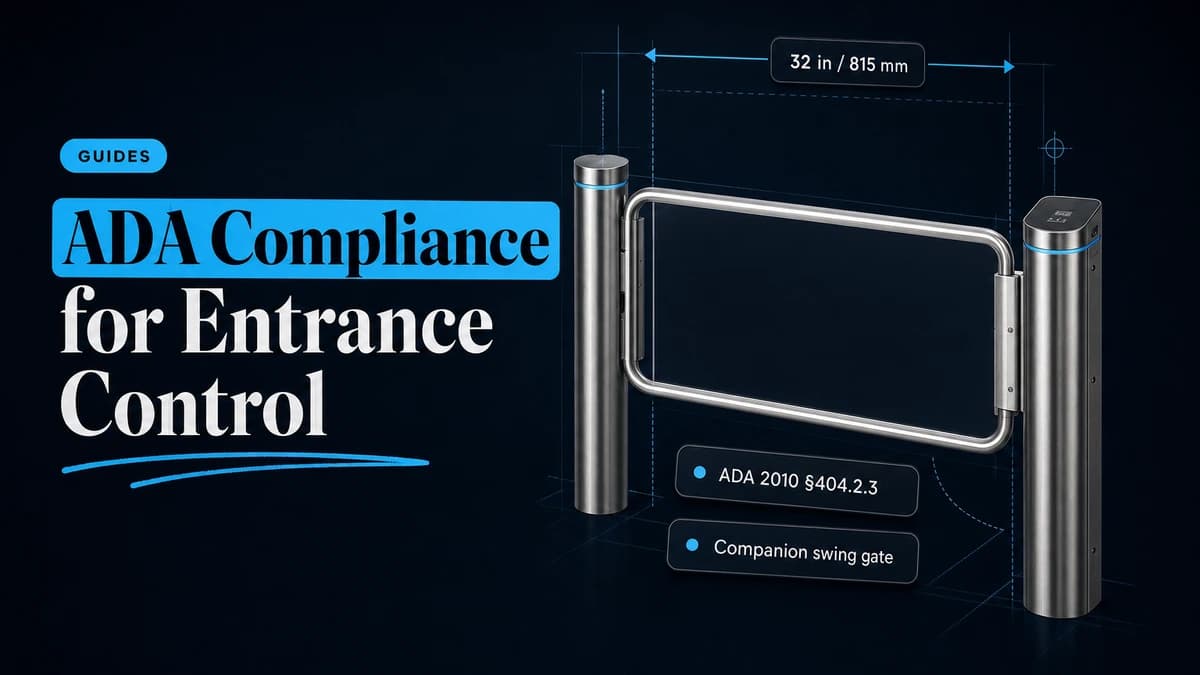
Accessibility is one layer of a larger spec decision. For the hardware itself see the full-height turnstile buyer's guide, for on-site clearances the installation site-prep checklist, and for budgeting the 2026 commercial turnstile cost guide.
The rule that governs the design
Clear width is measured at the narrowest point of the passage with the barrier open. It is not the cabinet-to-cabinet dimension; readers, glass, and arm geometry reduce the usable opening. Always design to the clear width, not the nominal lane width.
The two compliant patterns
| Product | Standard lane | Compliant configuration |
|---|---|---|
| Optical speed gate (single) | ~22 in | Specify wide-lane variant: 32–36 in clear |
| Optical speed gate (double-wide) | n/a | ~39 in, single product serves as the accessible passage |
| Tripod turnstile | ~22 in | Pair with an ADA swing gate at the same control point |
| Three-quarter / full-height | ~22 in | Pair with an ADA swing gate or wide swing |
The practical consequence shapes product selection. A bank of three tripods needs a fourth lane, an ADA swing gate, adding hardware and install cost. A bank of optical speed gates can fold the accessible passage into one wide lane. This is a major reason mid-traffic offices land on optical: once you price in the ADA companion that mechanical lanes require, the cost gap narrows. If the project is full-height perimeter hardware, the full-height buyer's guide covers the rotor-lane companion-gate plan.
Beyond width: force, timing, and egress
Width gets the headline, but three more factors decide whether a lane actually works for a person with a disability:
- Operating force. The accessible passage must open without requiring tight grasping, pinching, or twisting, and with low force. Powered swing gates and optical barriers satisfy this; a heavy manual gate may not.
- Timing. The barrier must stay open long enough for a slower passage. Configure the open-dwell time on the accessible lane for mobility-aid users, not for peak throughput.
- Egress. The accessible route must work in both directions and fail safe. On a fire-alarm signal and on power loss, the accessible lane must free-open like the rest.
Signage and the route
The accessible passage must sit on an accessible route, with no steps, thresholds, or obstructions leading to it, and should be identified so a visitor can find it without asking. Place the accessible lane where the route naturally leads, not tucked at the far end of a bank. The US Access Board's guide to entrances, doors, and gates is the primary-source read on how the accessible route connects to the entrance. The same accessible-route rule applies to a mantrap-style entry; our access control vestibule guide covers how ADA and egress requirements apply to an interlocked-door or rotating-enclosure mantrap specifically.
Common inspection failures
Frequently asked questions
- A standard turnstile or speed gate lane runs about 22 inches of clear width, which is below the 32-inch minimum the 2010 ADA Standards require for an accessible route (§404.2.3). To comply, you either specify a wide-lane optical gate with 32 inches or more of clear passage, or pair the standard lanes with at least one ADA-width swing gate at the same control point.
Keep reading
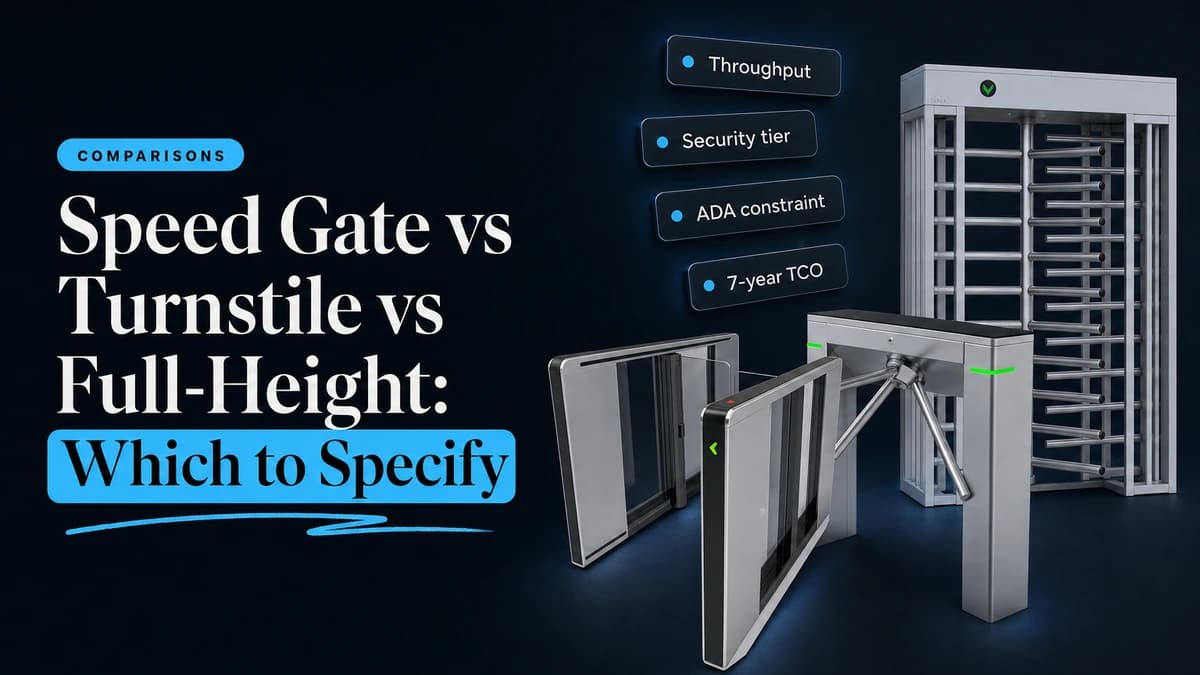
Speed Gate vs Turnstile vs Full-Height: A US Specifier's Guide (2026)
The 2026 specifier's guide to speed gates vs tripod vs full-height turnstiles. Throughput, security tier, ADA and NFPA, vertical fit, and 7-year TCO.
Gatestile Engineering Team
Apr 29, 2026
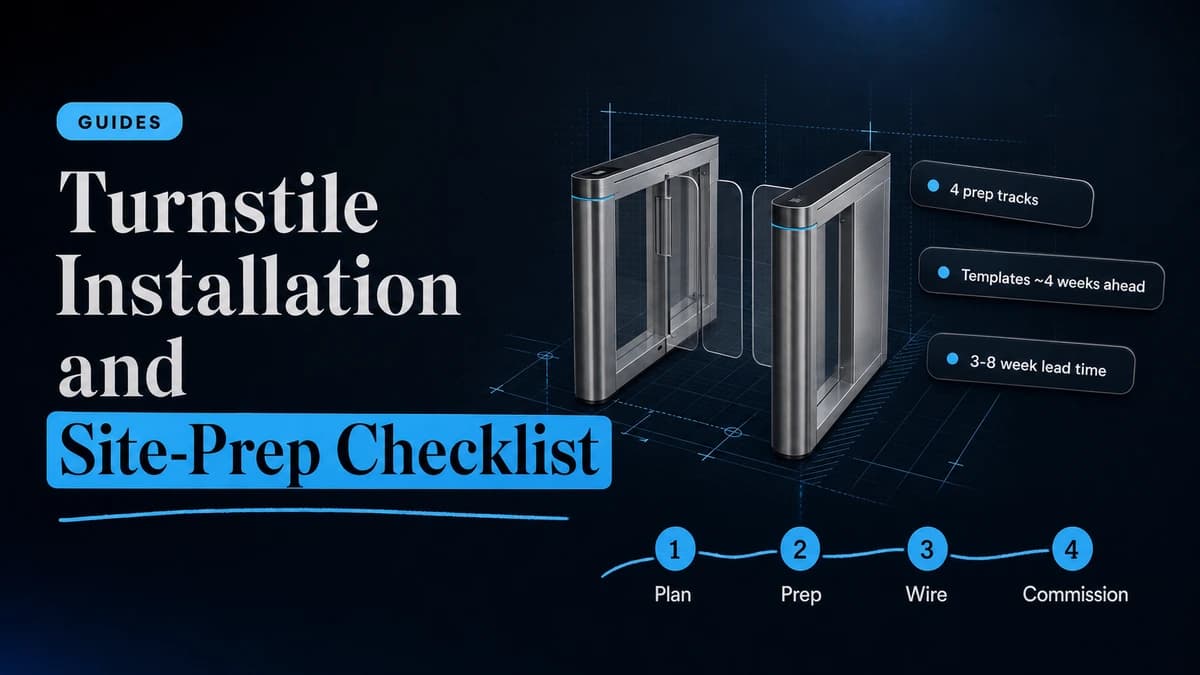
Turnstile Installation & Site-Prep Checklist (2026)
What to prepare before turnstiles arrive: power, conduit, flooring, structural blocking, surface vs embedded mounting, and lead-time sequencing for a smooth install.
Gatestile Engineering Team
May 29, 2026
 New
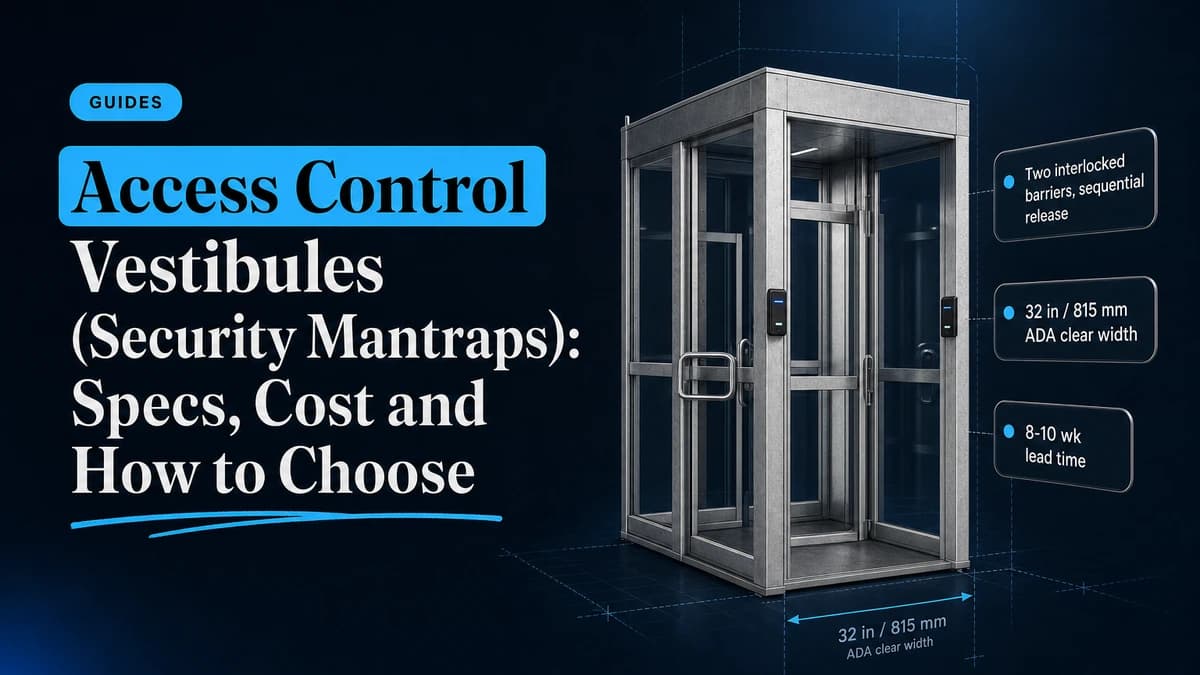
NewAccess Control Vestibules (Security Mantraps): Specs, Cost and How to Choose
What an access control vestibule is, how mantrap interlocks work, ADA and NFPA egress rules, real hardware options, and lead times to choose one.
Gatestile Engineering Team
Jul 24, 2026