

Guides
Access Control Gate Systems for Commercial Entrances
A buyer's guide to access control gates for commercial lobbies: ADA pedestrian swing gates paired with turnstile or speed gate arrays, specs, and lead times.

Gatestile Engineering Team
Engineering & Specifications, Gatestile
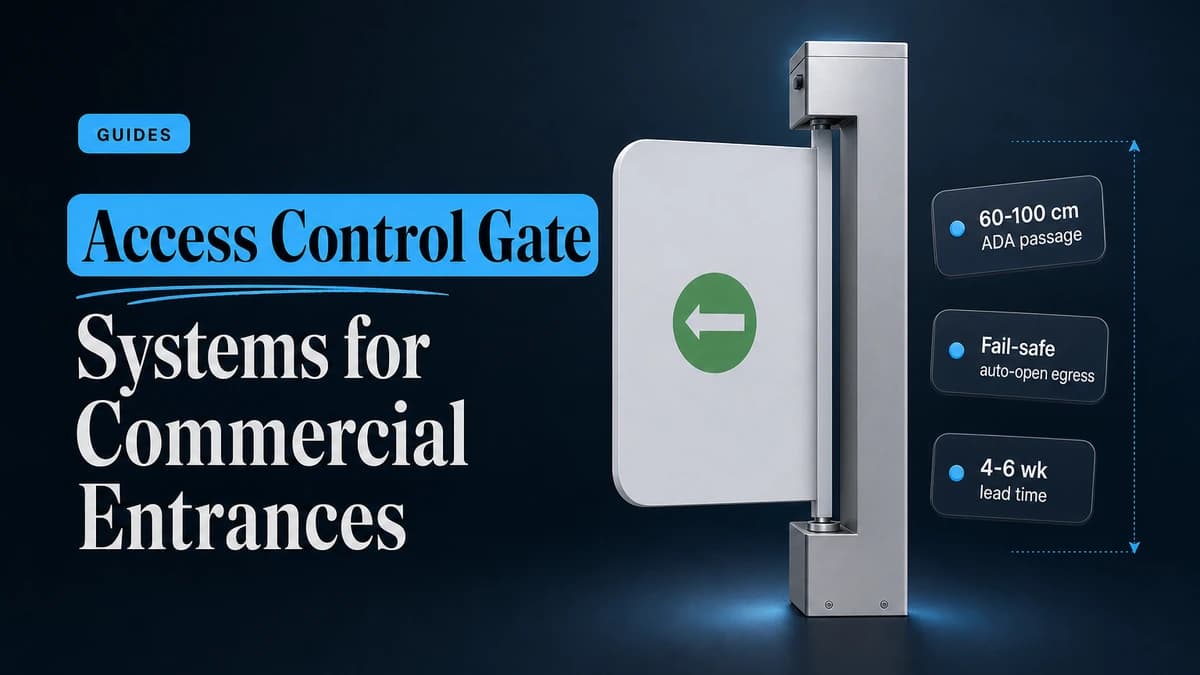
Search for "access control gates" and you will find two very different products under that phrase. Vehicular gate vendors use it for driveway swing and slide gate operators, keypad entry, and barrier arms. This guide is not about that hardware; Gatestile does not manufacture it. This guide covers commercial building entrances: pedestrian access control gates that pair with a turnstile or speed gate array in a lobby, not perimeter driveway gates. If you landed here looking for a vehicular gate opener, the rest of this article will not be useful to you.
What is an access control gate in a lobby setting
A pedestrian access control gate is a motorized barrier, most often a wide swing gate, that checks a credential at a reader and releases passage through a wing that swings open. In a commercial lobby it almost never stands alone. It is installed beside a bank of turnstiles or speed gates so the entrance has both a fast, narrow lane for regular traffic and a wide, accessible lane for anyone who cannot use a 22-24 inch turnstile passage: wheelchair and mobility-device users, deliveries, luggage carts, and stretcher or equipment transport in some settings.
Gatestile's version of this product is the SG-series swing gate line, four models built on one shared platform: a bi-directional motor wing, AISI 304 stainless frame (316 optional), and a roughly 1.5-second open and close cycle. The wing material and passage width are what differ between models, covered below. If you have not yet settled on the turnstile or speed gate side of the lane row, our speed gate vs turnstile vs full-height specifier guide walks through that choice first, and if you are still sorting out which kind of manufacturer to shortlist in the first place, our access control manufacturer guide explains the split between the physical-hardware vendor and the electronic access-control vendor.
When a building needs an access control gate
The short answer: any lobby that runs turnstile or speed gate lanes needs at least one accessible-width gate at the same control point, because a standard turnstile lane is too narrow to be ADA compliant on its own.
That is exactly the gap a swing gate fills. All four SG models clear 32 inches: the narrowest configuration (SG 112, 60 cm / about 24 inches) already exceeds it, and the wider models (SG 212 and SG 312, 80-100 cm / about 31-39 inches) give more margin for wheelchairs, carts, and two-way accessible traffic at the same lane. Our ADA compliance guide for entrance control covers the full accessible-route rule set if you are speccing the rest of the entrance at the same time.
| Situation | Why a swing gate applies |
|---|---|
| Any bank of tripod or speed gate lanes | Standard lanes run ~22 in clear width, below the 32 in ADA minimum; at least one wide lane is required |
| Wheelchair or mobility-device traffic expected | 60-100 cm (24-39 in) passage clears a wheelchair or scooter where a turnstile arm or optical lane cannot |
| Deliveries, luggage carts, or equipment through the lobby | The widest SG models (80-100 cm) pass carts and bulky items without propping a door |
| Egress path through the controlled entrance | Fail-safe auto-open on power loss or fire alarm keeps the route clear without manual override |
If you remember one line from this section, it is this: a turnstile or speed gate array without a paired accessible gate is not a complete, code-compliant commercial entrance.
The four Gatestile swing gate models
| Model | Code | Key specifications |
|---|---|---|
| VaneGlass wing · Box post · Most specified | SG 112 |
|
| RailFramed wing · Widest lane · 80–100 cm | SG 212 |
|
| ForgeStainless wing · Hygiene-grade · 80–100 cm | SG 312 |
|
| HaloLED wing · Round column · Most specified | SG WMC |
|
SG 112 (Vane) is the most-specified model: a 10 mm plexiglass wing on a slim stainless box post, 60-80 cm passage, about 34 kg. It is the standard accessible-lane companion for an office or lobby speed gate array.
SG 212 (Rail) is the widest lane in the line at 80-100 cm, with an aluminum-framed wing and glass infill. It is also the lightest build (about 27 kg) and the lowest power draw in use (19 W), which makes it the pick when the priority is maximum clear width for wheelchairs, carts, and deliveries.
SG 312 (Forge) swaps glass for a full AISI 304 stainless wing, aimed at wash-down or high-wear settings where there is no glass panel to scratch or clean around. Same 80-100 cm passage as the Rail, with the lowest power draw in the line (17 W in use).
SG WMC (Halo) is the premium option: an LED-illuminated wing on a polished, mirror-finish round column, 60-90 cm passage, about 40 kg, the most substantial build in the line. It ships with a plexiglass wing and offers an optional tempered-glass wing at 60-70 cm. This is the model to specify when the accessible lane needs to match a high-end lobby's design language rather than just its function.
All four share the same underlying platform: 100-230 VAC / 47-60 Hz power, roughly 1.5-second open and close, 9 W standby, soft-stop motion, auto-closing, and audio warnings during operation.
Egress and fail-safe behavior
Every SG-series gate is fail-safe by design. On a power loss or a fire-alarm signal, the wing automatically opens in either direction for free, unobstructed passage. Soft-stop operation and configurable fail-safe behavior are built into the same control electronics across the line, so the gate does not need a separate emergency-release mechanism bolted on afterward.
How access control gates integrate with the rest of the lane row
The reason a swing gate belongs next to a turnstile or speed gate array, rather than as a separate system, is that it runs on the same access-control wiring. Gatestile swing gates expose the same Wiegand, OSDP, RS-485, and dry-contact interfaces as our speed gates and tripod turnstiles, so a single access-control panel manages a mixed lane row without separate controllers or licenses. That also means the gate can be configured to auto-open specifically for credentials flagged as accessibility-needs in your access-control system, or triggered by a separate proximity reader, wave sensor, or push button positioned at wheelchair height, independent of the standard badge read used at the turnstile lanes.
Because the gate shares control electronics, motor module, and sensor types with the speed gate line, a facility team learns one preventive-maintenance procedure for the whole lane row instead of two separate ones.
Lead time
Standard swing gate configurations run 4-6 weeks from our US operation. If the gate needs to match a specific speed gate finish or a custom glass tint in the same lane row, plan on 6-8 weeks so the finishes ship together. Both bands sit inside the 3-8 week range that covers Gatestile's product lines overall, with tripods on the fast end and glass rotating drums on the slow end. Repeat orders of an existing configuration typically ship faster than a first order.
A commercial entrance access-control system is rarely one product. It's a turnstile or speed gate array for standard traffic and a wide, code-compliant gate for everyone and everything else, wired to run off the same panel. Spec both at once and the lead times, finishes, and integration line up without a second project later.
Frequently asked questions
- In a commercial building entrance, an access control gate is a motorized pedestrian barrier, typically a wide swing gate, that verifies a credential before releasing passage. It is usually installed alongside a turnstile or speed gate array so the lane row has both a fast-throughput lane and a wide, ADA-accessible lane at the same control point.
Keep reading
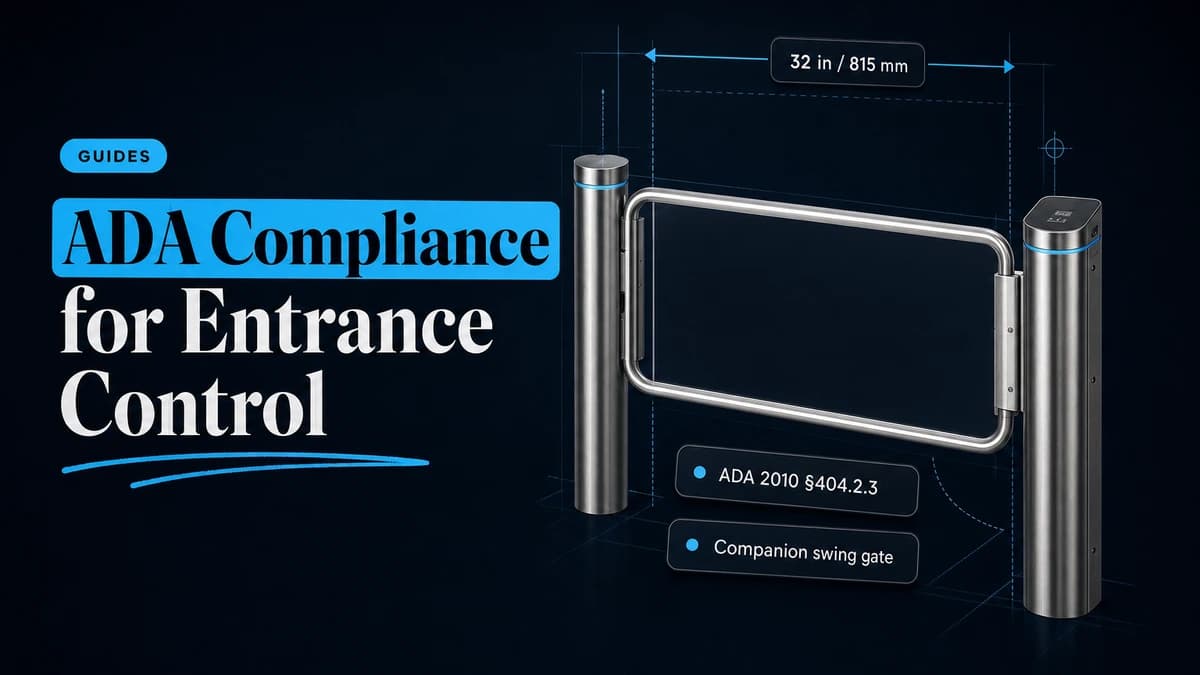
ADA Compliance for Entrance Control: A Specifier's Guide
How to keep a turnstile or speed gate install ADA compliant: the 32-inch rule, companion swing-gate lanes, force and timing, egress, and inspection failures.
Gatestile Engineering Team
May 29, 2026
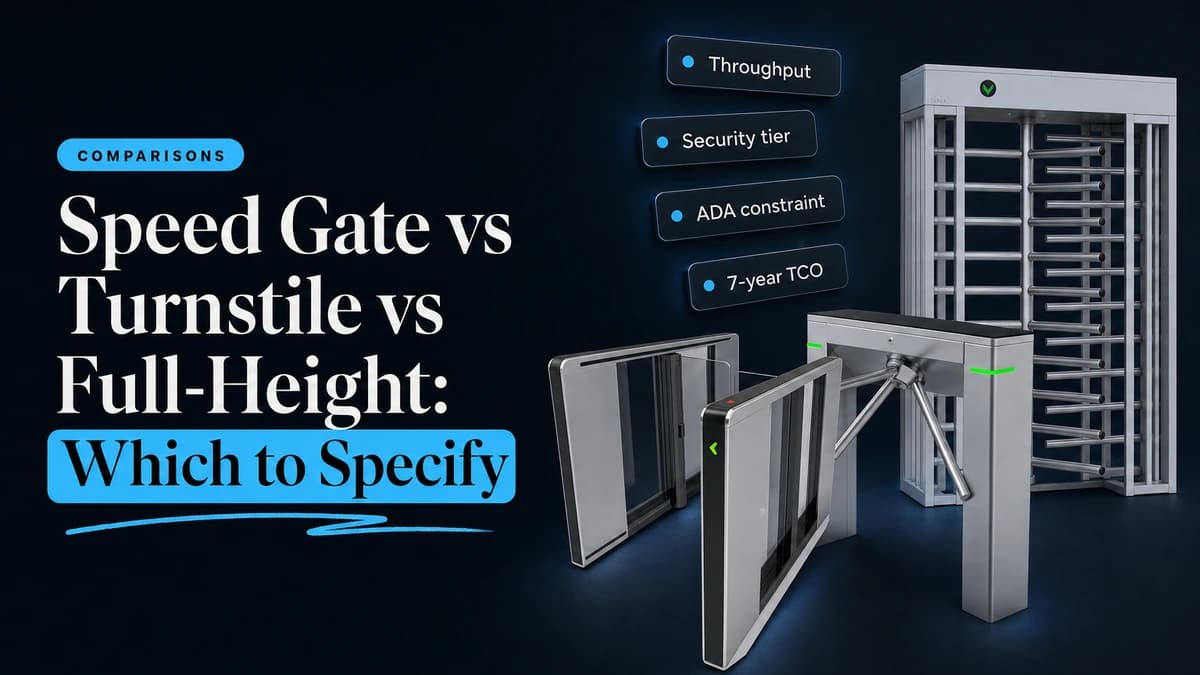
Speed Gate vs Turnstile vs Full-Height: A US Specifier's Guide (2026)
The 2026 specifier's guide to speed gates vs tripod vs full-height turnstiles. Throughput, security tier, ADA and NFPA, vertical fit, and 7-year TCO.
Gatestile Engineering Team
Apr 29, 2026
 New
NewUS Access Control Manufacturers: How to Choose the Right Category
Access control manufacturer searches cover two different vendor types. Learn the split, how they integrate, and which one your project actually needs.
Gatestile Engineering Team
Jul 28, 2026